 Else Beekman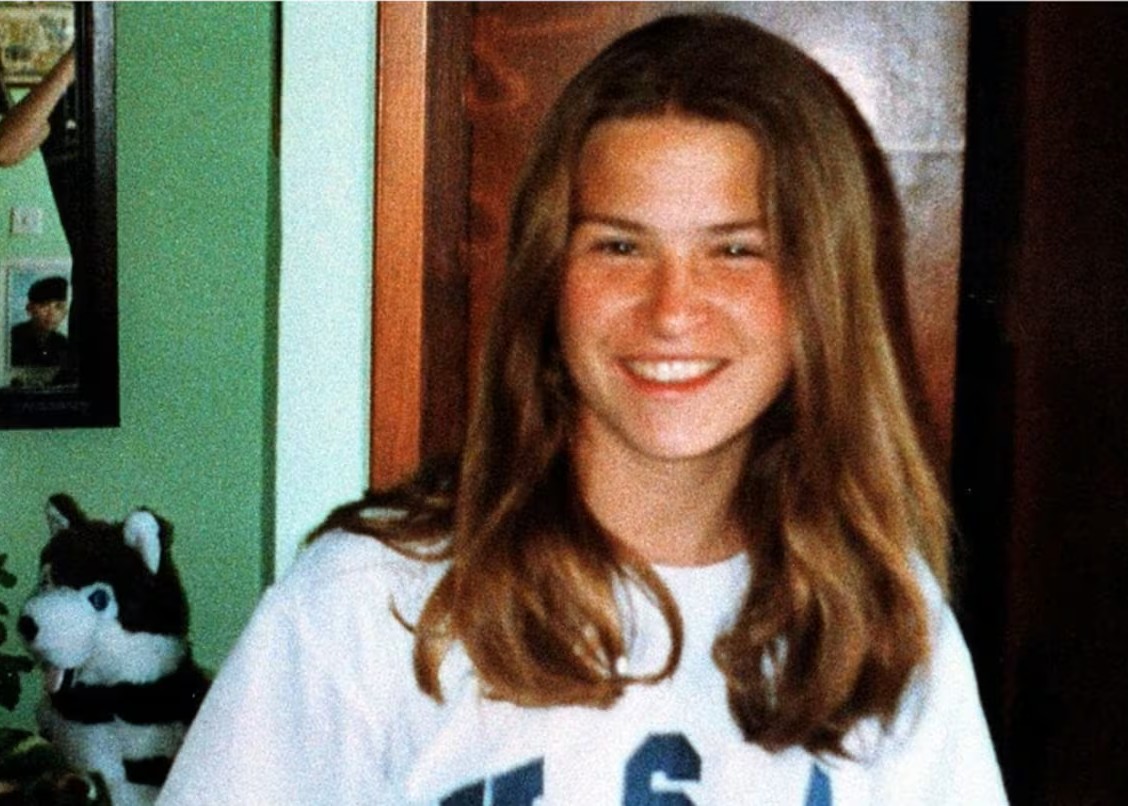
More than two decades after she was wrongly imprisoned for the brutal murder of Dutch teenager Rocío Wanninkhof, Dolores Vázquez has finally received public recognition—this time, not as a suspect, but as a survivor of Spain’s most infamous miscarriage of justice.
Once vilified and locked away, she was this week honoured by her hometown in Galicia for her dignity, endurance, and quiet fight to clear her name.
A case that shocked Spain, and destroyed a life
Rocío Wanninkhof was just 19 when she vanished in 1999 from the Costa del Sol town of Mijas, a place where village routines were beginning to collide with growing international tourism.
She had been raised in a protective, close-knit household by her mother, Alicia Hornos. Her father, Willem “Guillermo” Wanninkhof, a Dutch national, had returned to the Netherlands after leaving the family when Rocío was very young.
On the day she disappeared (9 October 1999) Rocío had been watching the Netherlands–Brazil football match with her boyfriend in Las Lagunas. Around 19:30, she left on foot to change clothes at her mother’s house, just 500 metres away. It was a short, familiar walk. She never arrived.
Her disappearance triggered widespread searches. Neighbours, police and volunteers scoured roadsides, coastal scrub and abandoned plots. Despite intense efforts, nothing surfaced for 24 days.
Then, on 2 November, her body was discovered in a rural area known as La Colina near Marbella, more than 30 kilometres from where she was last seen. It was partially hidden on difficult terrain and showed clear signs of a violent death. An autopsy confirmed she had died shortly after disappearing. Her death shocked the local community and left a family devastated.
A convenient suspect, and a catastrophic error
With no solid leads or witnesses, the investigation focused on Rocío’s immediate circle. The case was taken on by the Court of Instruction in Fuengirola, where detectives operated under the assumption that the killer must have been someone close to the victim.
Attention soon turned to Dolores Vázquez, the former partner of Rocío’s mother. The relationship had ended long before, and there had been no history of violence or threats. Yet police framed her as a resentful ex driven by jealousy.
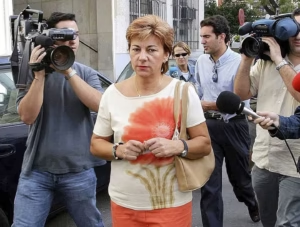
Dolores Vazquez
There was no physical evidence linking her to the crime. No DNA, no belongings of Rocío in her possession, no presence at the scene. Despite this, the investigation built a case around subjective interpretations of her behaviour and circumstantial testimony.
In 2001, Vázquez was convicted by a popular jury at the Provincial Court in Málaga and sentenced to 15 years in prison. The prosecution’s case rested entirely on a theory of revenge. Witnesses gave conflicting and vague accounts. Her appeal failed.
For 519 days, she sat in a cell, labelled a murderer in a case where no real proof had ever existed. The damage to her public image, personal life and mental health was profound.
Then, another girl disappeared
On 16 August 2003, nearly four years after Rocío’s murder and while Vázquez remained imprisoned, 17-year-old Sonia Carabantes disappeared after a night out in Coín, an interior town near Mijas. Her body was found days later. She had been raped and killed.
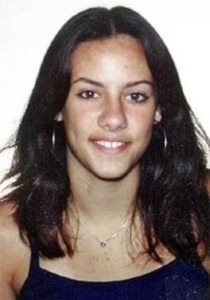
Sonia Carabantes
The case bore eerie similarities to Rocío’s. This time, though, investigators recovered DNA from the crime scene. It led them to Tony Alexander King, a British man with a record of sexual offences in Europe. He had been living in Spain under the radar.
Spanish police had previously received an Interpol alert about King, but the report had vanished into a forgotten drawer. No one had followed up.
When King’s DNA was compared to evidence from the Wanninkhof case, it matched. Fingerprints on the plastic sheeting used to wrap Rocío’s body also belonged to him.
The truth was now undeniable: Dolores Vázquez was innocent.
Life after prison, and a long-overdue apology
Vázquez was released in February 2004. Her conviction was annulled, but the court’s reversal came without any public apology or formal institutional reckoning.
After prison, she left Spain and spent nearly a decade in the UK, retreating from the media storm. It was only in the 2010s that she returned to Galicia, settling in her hometown of Betanzos.
There, in 2025, the town council awarded her a civic honour for her “dignity in the face of unimaginable suffering” and her role in exposing one of Spain’s gravest judicial failures.
A system exposed
The Wanninkhof case became a turning point in modern Spanish criminal justice. It exposed glaring gaps between the country’s main police forces, some of whom, at the time, operated with little coordination or communication.
Tony King’s crimes might have been prevented if earlier warnings had been acted upon. Instead, two young women died, and an innocent woman’s life was shattered.
King is now serving a long prison sentence. Dolores Vázquez, at last, is free. Not just in law, but in public memory.
Mijas crash unmasks British murder suspect hiding in plain sight