 Lorraine Williamson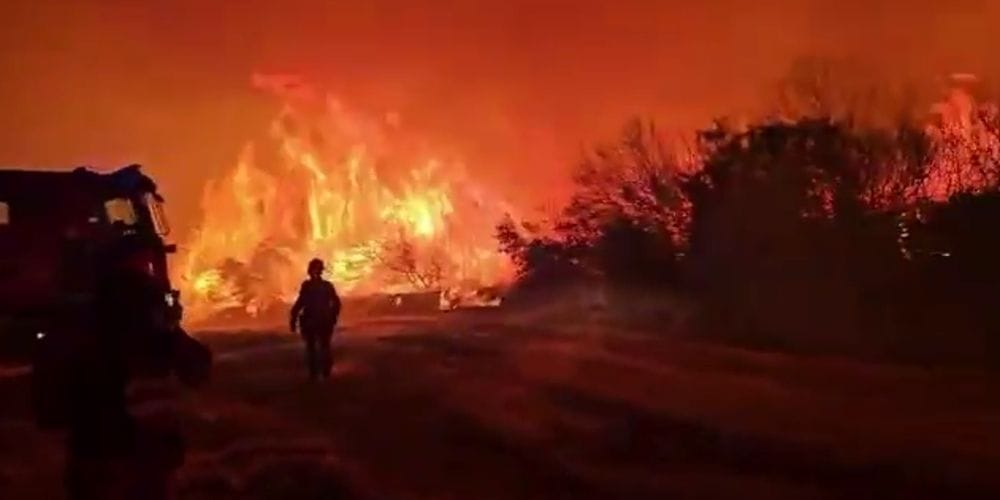
The wildfire spreading through Zaragoza’s Cinco Villas area has now burned around 12.000 hectares, with more than 1.000 people still unable to return to their homes.
The blaze remained out of control on Friday as emergency teams worked across a perimeter of approximately 60 kilometres. Aragón’s regional president, Jorge Azcón, described the fire as “extremely dangerous”, while crews continued defending evacuated villages and trying to prevent further expansion.
Six communities remain evacuated
Residents have been evacuated from Orés, Asín, Luesia, Malpica de Arba and Uncastillo in Zaragoza province, as well as Petilla de Aragón, a Navarran municipality surrounded by Aragón.
Many evacuees are staying with relatives or friends, while others have been accommodated in public buildings in Ejea de los Caballeros. More than 1,000 people are affected across the six communities.
Uncastillo, home to around 600 residents, faced one of the most dangerous periods of the emergency when the flames reached the surrounding area. Firefighters succeeded in protecting the town centre, although the landscape around the historic municipality was badly damaged.
Three regional roads remained closed on Friday. The fire continues at operational level two, with the Military Emergency Unit and resources from Navarra, Castilla y León, La Rioja and the Valencia region supporting the Aragón operation.
Fire expands sharply in two days
The estimated area affected has increased rapidly since the fire began near Orés on Wednesday.
Officials placed the burned area at approximately 4,500 hectares on Thursday morning. It had risen to around 7.600 hectares by Thursday evening and reached approximately 12.000 hectares on Friday.
The increase reflects the continued advance of several fire fronts despite intensive work by ground and aerial teams. High temperatures, dry vegetation, and low humidity have made it difficult for firefighters to establish a secure perimeter.
Aircraft returned after daybreak to support crews who had worked through the night protecting populated areas and reinforcing defensive lines.
Uncastillo surrounded by fire
Uncastillo became one of the main areas of concern after the flames moved towards the municipality.
Firefighters used roads, cultivated terraces, and natural breaks in the landscape to slow the advance. Although the built-up area was saved, the town’s mayor said the fire had devastated much of the surrounding countryside.
Emergency teams continue monitoring the different sectors of the blaze in case changing winds push the flames towards other communities.
Authorities said there was no immediate expectation of further evacuations, but warned that the situation could change quickly if weather conditions deteriorated.
Homes and farms damaged
Asín suffered the most serious confirmed property damage during the earlier stages of the emergency, when flames entered the village and affected several homes.
The full extent of the losses will not be known until assessment teams can safely enter all affected areas. Agricultural buildings, fields, woodland, grazing land, and livestock may also have suffered significant damage.
For farming communities across Cinco Villas, the consequences will extend beyond the immediate emergency. Even where homes remain standing, the loss of crops, machinery, pasture, and access routes could have a lasting economic impact.
Residents wait to return
Some residents have now spent several nights away from their homes, often without knowing whether their properties or farms have survived.
Emergency accommodation, food and practical support are being provided in Ejea de los Caballeros. Many other residents have stayed with family members or friends elsewhere in the region.
Authorities have not confirmed when people will be allowed to return. Roads, electricity supplies, surrounding vegetation, and the risk of renewed outbreaks must all be assessed before evacuation orders can be lifted.
The uncertainty is particularly difficult for residents who initially expected to leave for only a few hours but have now watched the fire spread across thousands of hectares.
Large emergency operation continues
The response includes Aragón’s regional wildfire service, the Military Emergency Unit, national government resources and teams from several neighbouring autonomous communities.
Ground crews are being supported by aircraft, heavy machinery, and agricultural tractors used to remove vegetation and create firebreaks.
The scale of the perimeter and the simultaneous threats to several villages have forced commanders to divide the blaze into operational sectors. Resources are being concentrated on the flanks considered most dangerous to people, homes, and infrastructure.
Even if the fire’s forward movement is halted, fully controlling and extinguishing a blaze of this size is likely to require a prolonged operation.
Other major fires across Spain
The Zaragoza emergency is unfolding as firefighters tackle other serious wildfires elsewhere in Spain.
A fire in La Mierla, in Guadalajara’s Sierra Norte, had burned around 2.000 hectares and forced the evacuation of six communities and a children’s camp. More than 350 personnel were involved in the response, including approximately 100 members of the Military Emergency Unit.
The latest incidents follow the deadly wildfire around Los Gallardos in Almería, where communities suffered severe loss of life and widespread destruction earlier this month.
Firefighters focus on protecting villages
The immediate priority remains preventing the fire from reaching more populated areas while crews attempt to contain its most active flanks.
Residents of the six evacuated communities will remain away from their homes until officials determine that the villages, roads, and essential services are safe.
Changing winds, high temperatures, and very low humidity could still influence the direction and speed of the blaze.
For now, the Zaragoza wildfire remains active, uncontrolled and capable of further expansion.