 Lorraine Williamson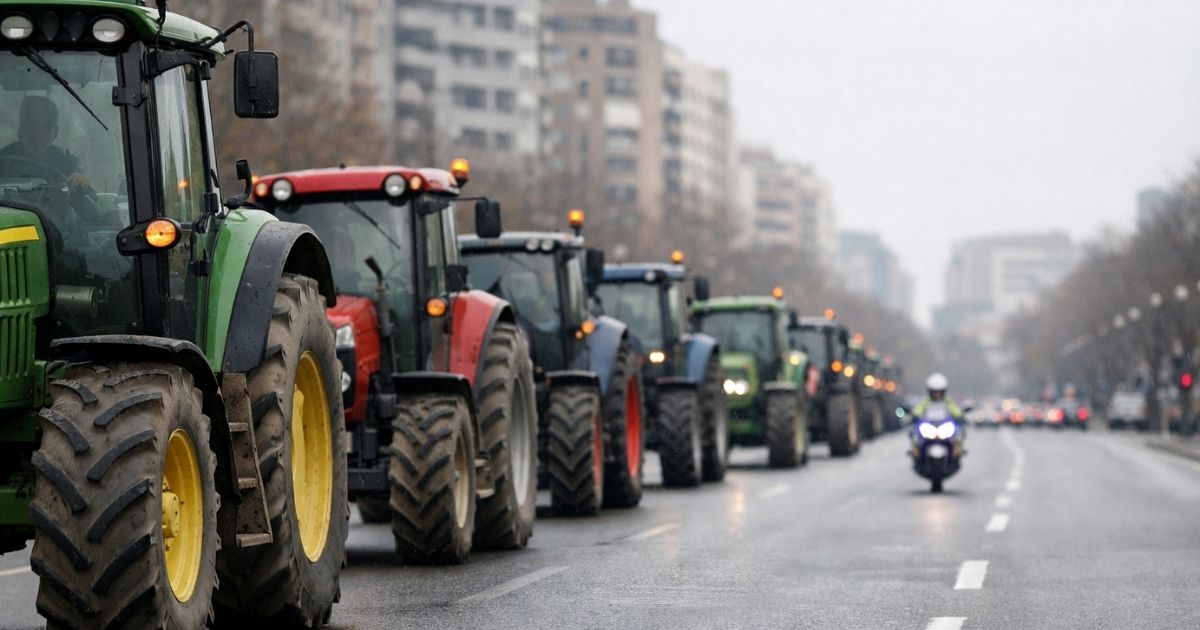
Valencia farmers tractor protest organisers didn’t choose a quiet stage. On Thursday morning, a convoy of agricultural vehicles rolled from the edges of the city towards the centre, turning a day of rural anger into an urban traffic headache — and a political message aimed as much at Brussels as Madrid.
The mobilisation is part of what farming groups have dubbed the Spanish countryside’s “super Thursday”: a coordinated day of actions across Spain focused on trade, subsidies and what organisers call “suffocating” bureaucracy.
A convoy with a deliberately symbolic starting point
In Valencia, the tractor convoy was set to begin at 10.00 am outside the Confederación Hidrográfica del Júcar (CHJ) on Avenida Blasco Ibáñez — a pointed choice in a region where water policy, irrigation access and environmental rules are constant flashpoints.
Organisers said tractors would arrive in the city from both north and south approaches, with a route taking in landmarks including the Torres de Serranos before finishing at the Delegación del Gobierno, where union leaders planned speeches. Police escorts were expected, along with significant disruption for drivers.
Why Mercosur has become the flashpoint
At the centre of this Valencia farmers tractor protest is the EU’s agreement with Mercosur (the South American trade bloc). Farming organisations argue it bakes in unfair competition: imported produce entering at scale, while European farmers face tighter requirements on plant protection products, labour rules and environmental compliance. They want “reciprocity”, credible impact assessments, and safeguard clauses they believe would actually bite if imports surge.
EU institutions insist safeguards and monitoring are built into the framework, with specific instruments designed to protect the agri-food sector in the event of market disruption.
The other fight: CAP funding after 2027
Trade isn’t the only anxiety running through Thursday’s protests. Farmers are also pushing back against how the Common Agricultural Policy (CAP) might be reshaped after 2027.
The European Commission has framed its post-2027 CAP plans as simpler and more targeted, including changes to how funding instruments are structured. But critics across the sector fear agriculture could lose its protected “standalone” status inside the EU budget, forcing farm support to compete more directly with other priorities and potentially widening disparities between member states.
“Not just a farmers’ issue”: the food-security argument
Organisers in Valencia have tried to broaden the pitch beyond the sector itself — calling on consumers to see these disputes as household issues. The argument is blunt: if domestic production is squeezed out by costs and regulation while imports rise, Europe becomes more dependent on external supply at exactly the moment geopolitics is becoming less stable.
What Valencia residents need to know today
If you’re in the city, the practical impact is straightforward: slow-moving vehicles, road restrictions along the convoy route, and knock-on delays as traffic is diverted. If you can, avoid driving through the centre during the main movement window and check public transport updates before setting off.
Spain-wide pressure, not a one-off
Valencia isn’t acting alone. Elsewhere on the same day, hundreds of tractors were reported in actions such as Valladolid, with organisers repeating a shared message: stop Mercosur as currently framed, reduce administrative load, and protect farm incomes to keep rural areas alive.
A broader list of demands — and a warning to policymakers
Alongside Mercosur and CAP reform, farming groups continue to raise a long-running catalogue: tighter controls on imports, tougher enforcement against selling below cost, support for climate losses, better protections against rural theft, and labour rules that reflect seasonal realities. The underlying point is that this is not a single-issue protest — it’s a challenge to the direction of agricultural policy in both Spain and the EU.
Sources: Cadena SER, Europa Press, European Commission, Europa,eu, Consilium