 Lorraine Williamson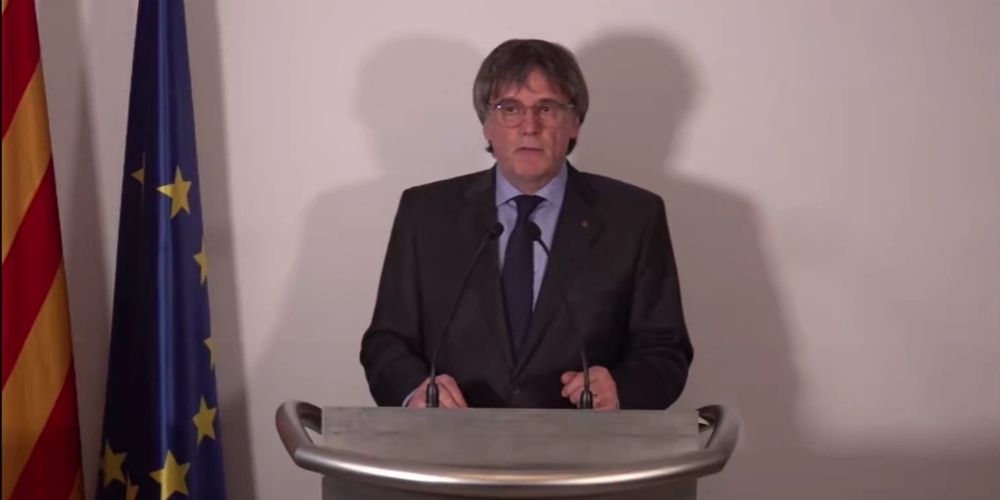
Former Catalan president Carles Puigdemont has moved a major step closer to returning to Spain after almost nine years in Belgium, following two significant court decisions on Tuesday.
Supreme Court judge Pablo Llarena suspended the national search and arrest order against Puigdemont with immediate effect after the Constitutional Court backed applying Spain’s amnesty law to the misuse of public funds offence linked to the Catalan independence procés. The measure also applies to former Catalan ministers Toni Comín and Lluís Puig.
The decision means Puigdemont is not currently at risk of being arrested under the national order if he enters Spain. However, Llarena’s ruling is provisional and does not yet formally apply the amnesty to Puigdemont or extinguish his criminal liability.
The judge said the arrest orders would remain suspended until a further judicial decision, while he examines the Constitutional Court’s full judgment and determines its consequences for the three men.
Constitutional Court backs amnesty for misuse of public funds
The development followed a ruling by the Constitutional Court on Tuesday concerning former Catalan minister Dolors Bassa. By seven votes to five, the court upheld her appeal against the Supreme Court’s refusal to apply the amnesty law to the misuse of public funds offence.
The Constitutional Court concluded that the Supreme Court’s interpretation had departed from the purpose of the amnesty legislation. The ruling establishes a precedent relevant to other former Catalan leaders facing comparable proceedings, including Puigdemont.
The full judgment has yet to be examined by Llarena. However, the Supreme Court judge considered the circumstances sufficiently similar to justify immediately suspending the arrest orders rather than risk a detention that could subsequently prove unjustified.
Puigdemont stops short of announcing return date
Speaking from Waterloo in Belgium on Tuesday evening, Puigdemont welcomed the Constitutional Court’s decision but did not announce when he intends to return to Spain. In a statement also published on X, he described the outcome as a “victory of the amnesty” and argued that it should bring to an end what he characterised as nine years of political repression.
Puigdemont stressed that he did not regard the amnesty as resolving the wider dispute over Catalonia’s relationship with Spain. “In terms of the Catalonia-Spain relationship, nothing is resolved today,” he said, adding that the amnesty formed part of a possible formula for resolving the conflict but was not, in itself, the solution.
He also reiterated his support for Catalan self-determination, and said those who had left Spain following the events of 2017 intended to return with the same political purpose with which they had gone into exile. He gave no timetable for his own return.
His lawyer, Gonzalo Boye, has been more explicit about the conditions for a return. Speaking to RNE, Boye said Puigdemont does not intend to return until the Supreme Court has actually applied the amnesty to him, stressing the legal distinction between suspending an arrest order and formally granting the amnesty.
Nearly nine years outside Spain
Puigdemont left Spain for Belgium at the end of October 2017, days after the Catalan parliament approved a declaration of independence and the Spanish government invoked Article 155 of the Constitution to take direct control of the autonomous administration.
He has remained outside Spain for most of the period since. Meanwhile, he continues to play a prominent role in Catalan politics. His legal position became one of the central issues surrounding the amnesty law agreed during the formation of Pedro Sánchez’s government after the 2023 general election.
The law was intended to cover people facing criminal proceedings arising from the Catalan independence process. However, its application to the misuse of public funds became the subject of a prolonged judicial dispute.
The Supreme Court had previously concluded that the circumstances surrounding the misuse of public funds offence meant the amnesty could not apply in the cases of several procés leaders. Tuesday’s Constitutional Court decision challenges that interpretation and is expected to have consequences for other outstanding cases.
Return now depends on final legal steps
Despite Tuesday’s breakthrough, Puigdemont’s return should not yet be treated as confirmed or imminent.
The national arrest order has been suspended, but Llarena has explicitly made that decision temporary while the Supreme Court considers the Constitutional Court judgment. Puigdemont’s defence has indicated that he will wait for the amnesty to be formally applied before returning.
That leaves the timing uncertain, although the legal obstacle that had previously exposed him to immediate arrest on entering Spain has, for now, been removed.
The decision also comes at a particularly sensitive political moment. Spain is heading towards a general election on 29 November, while Junts remains a significant force in Catalan and national politics. Puigdemont’s eventual return after almost nine years outside Spain would therefore take place against a markedly different political backdrop from the one he left in 2017.