 Lorraine Williamson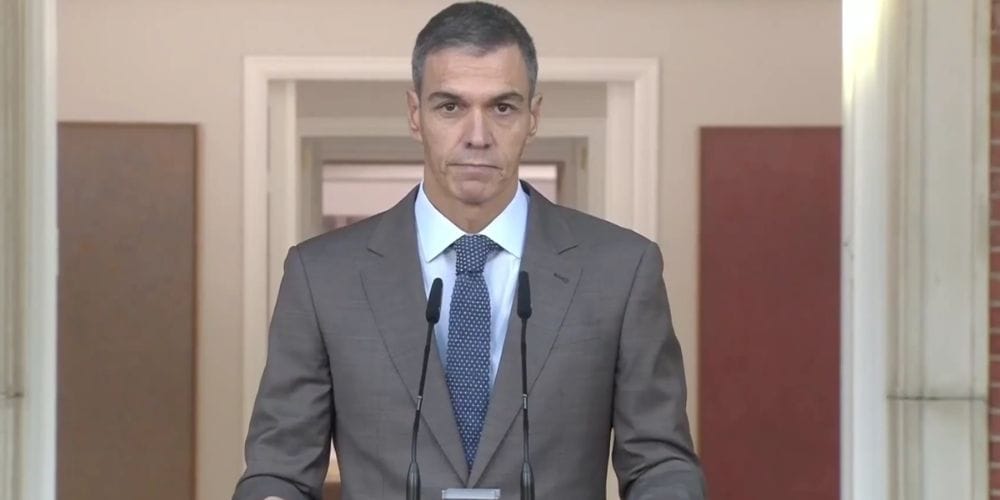
Pedro Sánchez has called an early Spanish general election for Sunday, 29 November 2026, bringing the current legislature to an early end. The prime minister announced his decision from La Moncloa on Monday morning after a weekend of consultations triggered by the government’s defeat in Congress over two major housing decrees.
Sánchez said he had informed King Felipe VI of his decision and called an extraordinary meeting of the Council of Ministers on Monday morning to begin the process of dissolving the Cortes Generales. The election decree is due to be published on Tuesday, 6 October, setting in motion the timetable for Spaniards to vote on 29 November.
In his statement, Sánchez acknowledged that his government had made mistakes and had not achieved everything it intended. He argued, however, that further reforms would require renewed and broader public support, telling voters that the decision over Spain’s future now rests with them.
Housing defeat brings legislature to an early end
The announcement follows Friday’s dramatic defeat of two government housing decrees in the Congress of Deputies. Junts joined the PP and Vox in voting down the measures, exposing once again the difficulty the coalition government has faced in assembling parliamentary majorities for key legislation.
Among the proposals was an extension of protections against certain evictions until 2030. The measures came amid mounting public pressure over housing affordability, with demonstrations across Spain demanding stronger action on rents and access to homes.
The parliamentary defeat prompted Sánchez to spend the weekend consulting members of his government and senior PSOE figures over whether the legislature could realistically continue. By Monday morning, he had decided that voters should determine what happens next.
Why Sánchez says Spain should vote again
Sánchez used Monday’s address to defend his coalition government’s record, pointing to economic growth, employment, social policies, renewable energy, and Spain’s international role. At the same time, he acknowledged dissatisfaction among parts of the government’s traditional support base, particularly over inequality, public services, and access to housing.
The prime minister said further reforms would require the government to “renew and expand” its public support and secure a broader progressive majority in parliament. He presented November’s election as a choice over Spain’s future direction, drawing a clear dividing line between his government’s programme and the prospect of a PP-Vox administration.
Housing is therefore likely to become one of the defining issues of the campaign, but it will not be the only one. The economy, cost of living, immigration, public services, and the government’s record since 2023 are all expected to feature heavily during the weeks ahead.
Spain enters a 54-day election countdown
The formal electoral process begins with the dissolution decree, expected to be published in the Official State Gazette on Tuesday, 6 October. Spanish electoral law establishes the timetable following an early dissolution of parliament, putting polling day on Sunday, 29 November.
Candidate lists will be presented later in October before the formal election campaign begins in November. Following the dissolution of the chambers, the permanent deputations of Congress and the Senate will assume their constitutional roles until the new parliament is constituted.
Parties move rapidly into campaign mode
The announcement immediately changes Spain’s political landscape, giving the country’s parties less than two months to prepare for polling day. For the PSOE, Sánchez will seek to persuade voters that his government needs a stronger parliamentary mandate after more than three years of relying on agreements with a complex group of regional and left-wing parties.
The PP will see the election as an opportunity to replace Sánchez after repeatedly demanding an early vote, while Vox will enter another national campaign seeking to strengthen its position on the Spanish right. The balance between the PP and Vox could prove crucial in determining whether the right can assemble enough seats to govern.
Parties to the left of the PSOE also face important decisions over alliances and candidates. The Sumar political space had already begun accelerating its preparations over the weekend as speculation about an early election intensified, while regional parties including Junts, ERC, PNV, and EH Bildu could again become decisive if neither the left nor the right secures a clear parliamentary majority.
A very different election from 2023
Spain last held a general election in July 2023, when neither the left nor the right secured enough seats to govern alone. Sánchez eventually remained prime minister after lengthy negotiations produced sufficient parliamentary support for another PSOE-led coalition.
The political landscape has changed considerably since then. Housing has moved towards the centre of the national debate. Meanwhile, questions surrounding the cost of living, immigration, public services, and Spain’s economic performance are likely to compete for voters’ attention throughout the campaign.
The election will also test whether Sánchez can rebuild support among voters dissatisfied with the government’s progress while persuading others that political stability requires a stronger parliamentary mandate. For the opposition, the challenge will be converting years of criticism of the government into enough seats to produce an alternative majority.
Spain prepares for 29 November
The announcement ends the uncertainty that dominated Spanish politics throughout the weekend. What remained a possibility on Sunday is now a confirmed election, and the country’s political parties have only weeks to finalise candidates, alliances, and campaign strategies.
Spain will vote on 29 November, bringing the current legislature to an early close and giving voters the final say over who governs next. The campaign now begins, with housing likely to be one of the first major battlegrounds.