 Lorraine Williamson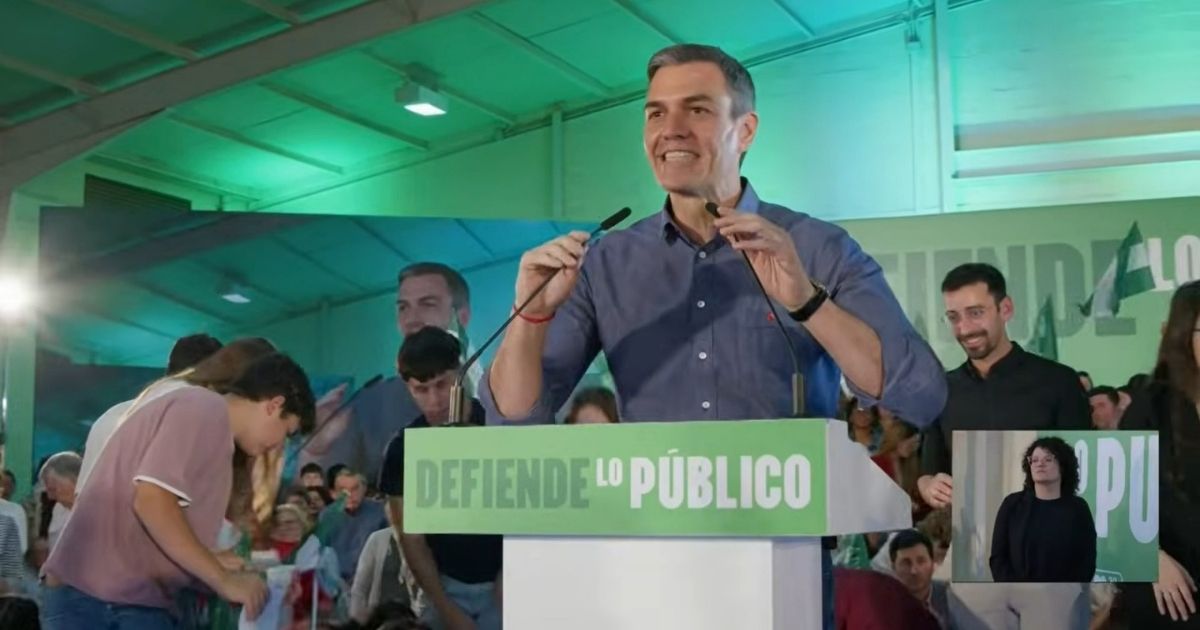
Spain will formally ask the European Union to break its association agreement with Israel, in what has become one of Pedro Sánchez’s sharpest foreign policy moves of the year. Speaking at a PSOE event in Gibraleón, Huelva, the prime minister said the proposal would be taken to Tuesday’s meeting of EU foreign ministers in Brussels.
The language was unusually direct. Sánchez said a government that violates international law and the values of the European Union “cannot be a partner of Europe,” framing the move not as a symbolic protest but as a formal demand for action inside the EU system.
Sánchez hardens Spain’s message
Pedro Sánchez also reinforced the message on X, saying: “The time has come for the EU to break its Association Agreement with Israel.” He added that Spain has “nothing against the people of Israel” but argued that “a government that violates international law, and therefore the principles and values of the EU, cannot be our partner.” He ended the post with a blunt appeal: “NO TO WAR.”
The step hardens a position Spain had already been developing. Earlier this week, Spain, Ireland, and Slovenia urged the EU to review its relationship with Israel, but Sunday’s announcement goes further by explicitly calling for the agreement to be broken. That makes this a new escalation, not just a repetition of the earlier diplomatic line.
It also reinforces Sánchez’s attempt to place Spain at the forefront of the European response to the war in Gaza and wider Middle East tensions. For Madrid, this is partly about diplomacy and partly about political identity: presenting Spain as one of the clearest voices within the EU, arguing that foreign policy should align with the bloc’s stated human-rights principles.
Gaza row between Spain and Israel deepens
The reaction has been immediate. Israeli foreign minister Gideon Saar accused Sánchez of hypocrisy, saying the Spanish leader was willing to target Israel while maintaining relations with authoritarian governments elsewhere. That response underlines how exposed Spain has become in this debate, both diplomatically and politically.
For readers in Spain, the story matters on several levels. It is first a major foreign policy move led directly by Madrid. But it is also part of a wider shift in how Sánchez is positioning Spain internationally: more willing to clash with allies, more willing to use the EU stage, and more willing to connect foreign-policy arguments to domestic political identity.
Brussels meeting
The next key date is Tuesday, when EU foreign ministers meet in Brussels. Spain will try to turn a national stance into a formal European debate. Whether it succeeds is another matter, but the line from Madrid is now unmistakable: Sánchez wants the EU to move from criticism of Israel to a much harder institutional response.