 Lorraine Williamson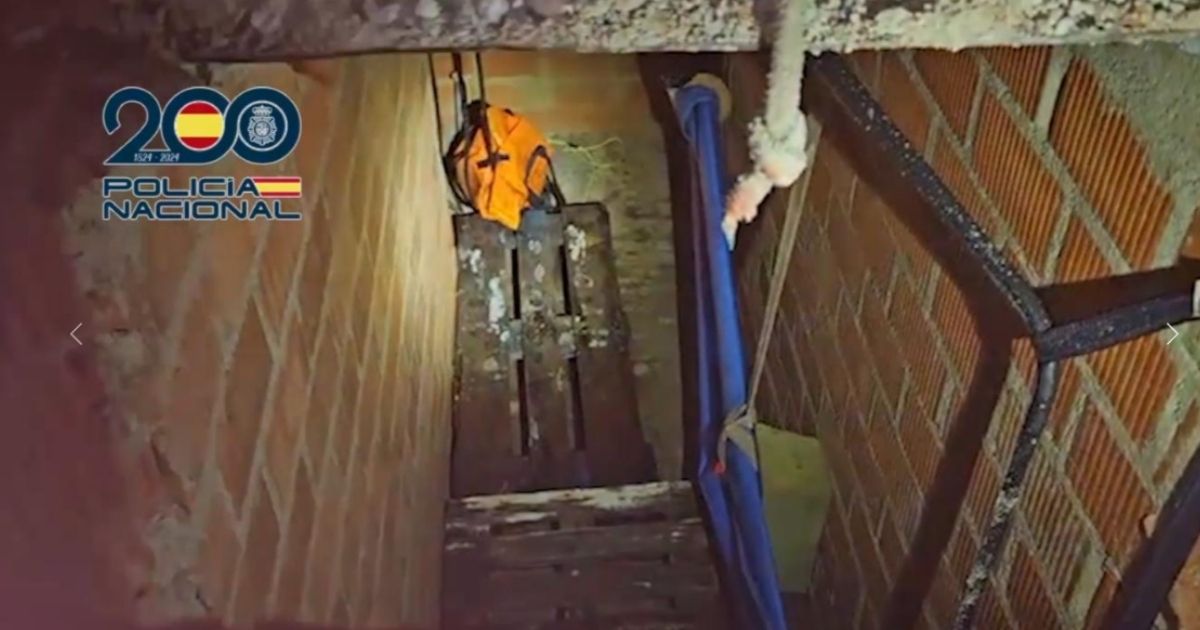
What looked two days ago like another striking twist in Ceuta’s tunnel story now appears to have been part of something far bigger. Spanish police say they have dismantled a major cross-border trafficking network after uncovering a hidden underground infrastructure designed to move tonnes of hashish from Morocco into Spain, with 27 arrests, more than 17 tonnes of drugs seized, €1.43 million in cash recovered, and 15 luxury vehicles confiscated.
The operation marks a clear escalation from the earlier reports about a second narcotunnel in Ceuta. According to the Policía Nacional and the Interior Ministry, investigators were dealing not simply with another tunnel, but with what they described as a “red de redes del hachís” — a network capable of moving large volumes of drugs into mainland Spain and on into Europe.
Hidden behind a soundproof fridge
Police say the entrance to the tunnel was concealed behind a large soundproofed refrigerator inside an industrial warehouse in Ceuta. Below it sat a three-level structure: a descent shaft, an intermediate chamber used to store drug bales, and a final tunnel line towards Morocco. The infrastructure included rails, wagons, pulleys and cranes designed to move heavy pallets of hashish with minimal risk and without direct visual contact between those involved.
That level of engineering is what turns this from a routine seizure story into something more extraordinary. Reuters reported that the tunnel sat beneath an industrial unit and used an underground rail system and cranes. Meanwhile, the official police account adds that powerful pumping and soundproofing systems were installed to keep the operation running without attracting attention.
From warehouse shaft to “narco pantry”
The police description reads more like a mine than a makeshift smuggling route. Investigators say officers had to descend through a shaft to a middle level where the hashish bales were stacked on pallets before extraction to the surface — what the press release effectively describes as a kind of “narcodespensa” or narco pantry. Below that, a more complex labyrinth began, with wagons running along carefully built rails.
Two drainage pumps were needed to keep the structure operational because of underground water deposits, and police say the warehouse had been acoustically conditioned so the machinery could run continuously without outsiders noticing. That detail helps explain how such a large and technically complex system could remain hidden for so long.
A long investigation that kept widening
The operation did not begin with the tunnel itself. Policía Nacional says the investigation started in February 2025, when officers focused on a criminal group based in Ceuta with the capacity to move large quantities of hashish into mainland Spain and the wider European market. Surveillance later identified two figures at the top of the organisation: one allegedly based in Morocco and another operating in Ceuta, where deals were negotiated, and shipments agreed.
The case widened over time. A house fire in Ceuta’s Príncipe district led to the seizure of 510 kilos of hashish and linked that property to the group’s logistics, according to police. In May and June, the network allegedly showed it could move huge loads by heavy goods vehicle, including 432 kilos seized in Cabrerizas Altas and, most dramatically, 15,000 kilos intercepted in Almería in a lorry coming from Nador.
The network stretched far beyond Ceuta
By summer, investigators say they had uncovered maritime links too. Police report that the network used high-speed boats to bring drugs in via the Andalucian coast and the Guadalquivir, and that the main suspect had contacts with narcolancha coordinators in La Línea de la Concepción as well as individuals in Galicia involved in moving the drugs by fishing boat. After the southern route was hit by the 15-tonne seizure, officers say the group even explored shifting imports northwards to Galicia.
That broader geography matters because it shows the case was never just a Ceuta curiosity. By the final quarter of last year, police say the network’s reach and danger had become clearer still. In November, officers seized 480 kilos of hashish after a pursuit in the Málaga area, and by December, investigators believe the organisation was already considering the tunnel as its main route for getting narcotics into Spain.
250 officers, 29 searches, 27 arrests
With the evidence in place, police launched a large-scale operation involving more than 250 officers. They carried out 29 searches at addresses in Ceuta, Marbella, Villablanca, Los Barrios and Pontevedra, seizing a further 228 kilos of hashish, 88 kilos of cocaine, 66 communications devices, cash and luxury cars. The final tally given by police was 27 arrests, more than 17 tonnes of drugs, €1.43 million in cash and 15 luxury vehicles.
El País reported that investigators believe a single “narcoarchitect” was behind both Ceuta tunnels and that the same network may have had both infrastructures operational at one stage. Reuters, meanwhile, highlighted the bigger European context: Spain remains one of the main entry points for cannabis resin into Europe, accounting for 68% of all EU cannabis resin seizures in 2023.
Why this update matters
For readers who saw the earlier tunnel story, tonight’s development changes the scale of the picture. This is no longer just about the existence of a second underground route. It is about the alleged dismantling of a sophisticated trafficking system that linked Ceuta, Morocco, Andalucia and northern Spain, with the capacity to move industrial quantities of hashish and adapt quickly when one route came under pressure.