 Lorraine Williamson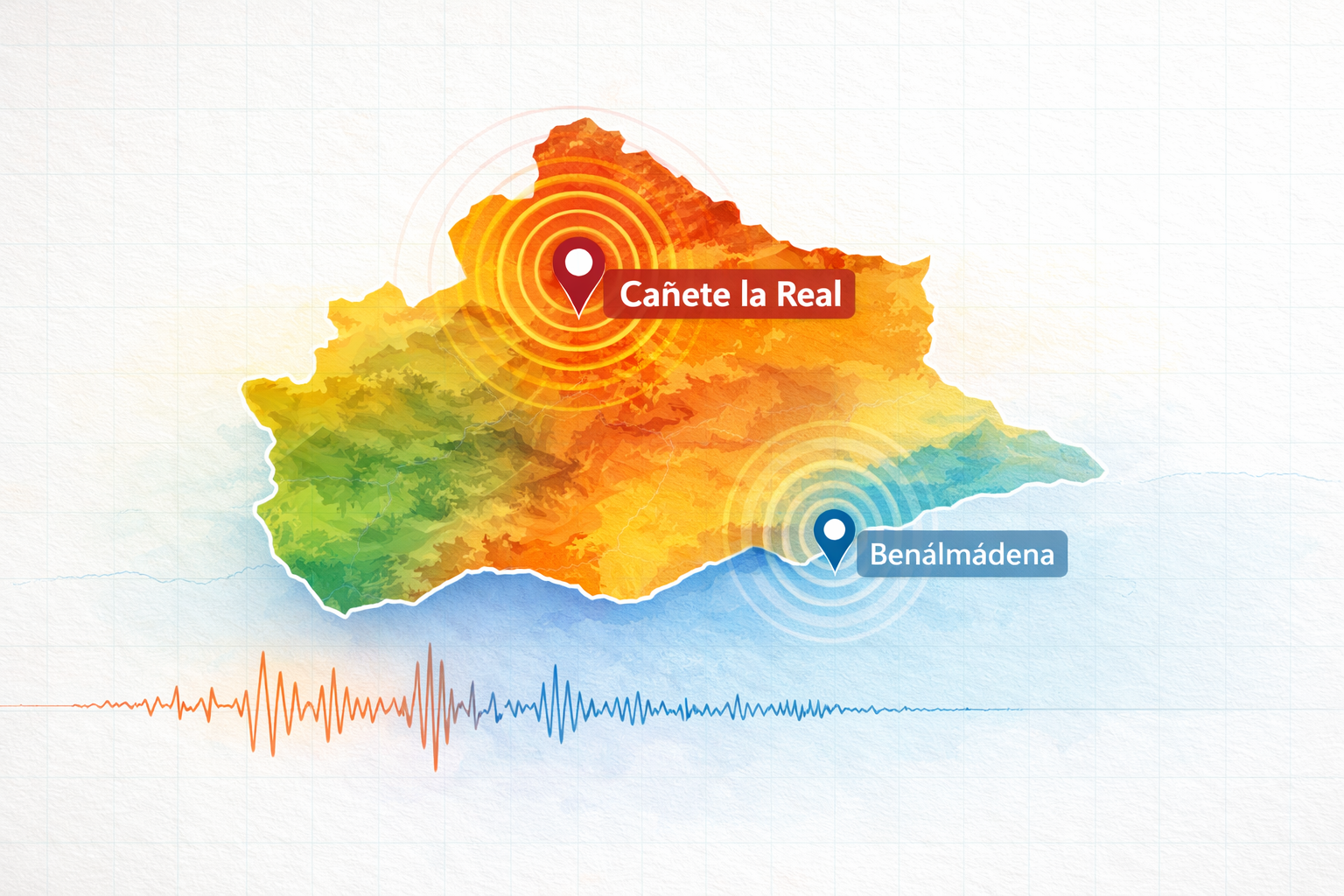
Málaga earthquakes this morning came in quick succession, with four tremors recorded within around two hours — three around Cañete la Real and another off Benalmádena on the Costa del Sol, according to data from Spain’s National Geographic Institute (IGN) reported by local and national outlets.
The strongest was logged at 8.22 am with a magnitude of 3.0 and a listed depth of 0 kilometres near Cañete la Real. Two smaller tremors hit the same area earlier at 7.53 am (1.9) and 7.59 am (1.7).
A separate quake was recorded near Benalmádena at 9.19 am, measured at 2.8 and much deeper — 63 kilometres — which helps explain why some people notice a faint wobble and others feel nothing at all.
“0km depth” sounds alarming — here’s what it usually means
The phrase “0km depth” reads as if the tremor happened on the surface. In practice, it’s more often a measurement rounding in automated reporting, or a sign that the quake was very shallow. Shallow quakes can feel sharper and more local, even when they are small.
A magnitude 3.0 is generally classed as minor. It’s the kind of event that can rattle windows, make hanging objects sway, and trigger plenty of WhatsApp messages — but it is not, by itself, a sign of a major quake on the way.
Why Benalmádena’s quake is different
Depth matters. A deeper tremor (like the one listed at 63km) can spread its energy over a wider area but often feels softer at the surface. A shallow tremor can feel more like a sudden jolt, even if the magnitude is similar.
That’s why residents sometimes report completely different experiences, even within the same town.
This isn’t happening in isolation
These morning tremors add to a busier-than-usual February for the western side of the province. Last week, the IGN recorded a 3.8 quake near Cortes de la Frontera, which was felt in parts of Málaga and Cádiz, including coastal towns.
None of that automatically equals danger — but it does explain why people are paying more attention right now.
If you felt it, the IGN wants to hear from you
Spain’s IGN runs a public macroseismic questionnaire that helps scientists map where a tremor was felt and how strongly. It’s useful even if you barely notice anything.
This kind of citizen reporting improves the “felt map” far beyond what instruments alone can capture.
What you should do (and not do) after a small tremor
Most people don’t need to do anything beyond common sense. If you’re in a building, check for obvious hazards (a shifted shelf, a cracked tile, a loose frame). Avoid rumours that leap straight to “earthquake swarm” panic.
If you ever feel a stronger quake: move away from shelves and glass, don’t run to lifts, and follow official guidance.