 Lorraine Williamson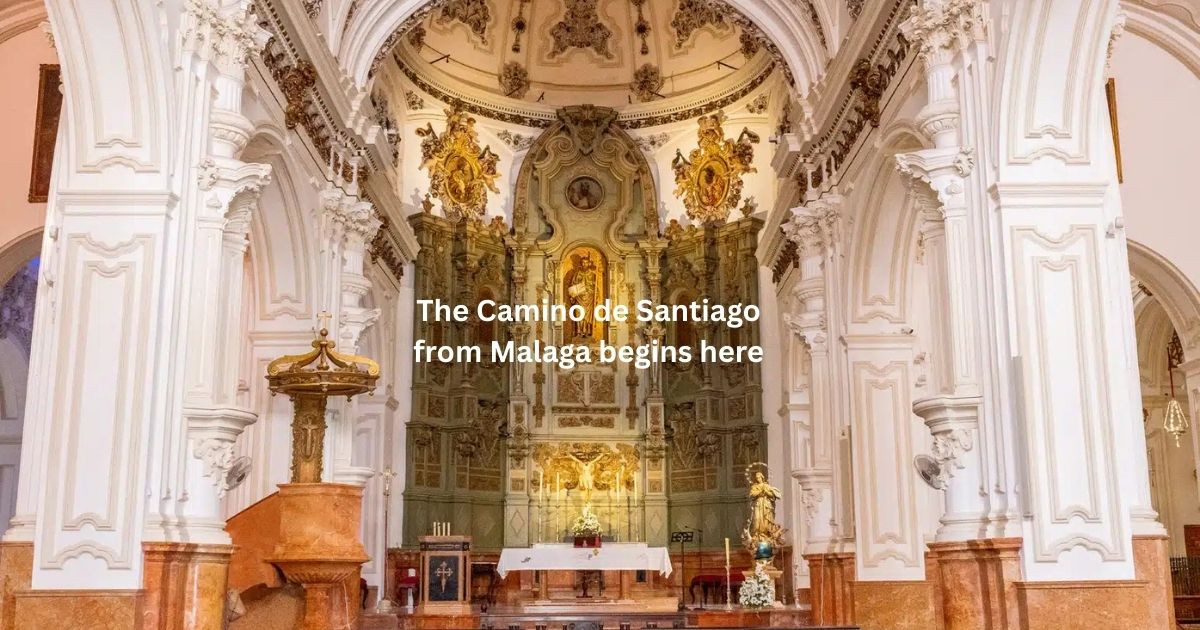
When most people picture the Camino de Santiago, they think of the busy northern routes, crowded with backpacks and scallop shells. Yet one of Spain’s most remarkable pilgrim trails begins much further south, beneath the Mediterranean sun.
The Camino de Santiago from Málaga, part of the ancient Mozarabic Route, winds northwards for nearly 1,500 kilometres, linking Roman roads, Moorish cities and medieval landscapes before arriving at the shrine of Santiago de Compostela.
A modest sign, a momentous beginning
Unlike the grand arrivals in Santiago, the departure from Málaga is almost understated. At the Church of Santiago on Calle Granada, a small plaque marks the start of a journey that once drew Christian pilgrims from Al-Andalus. From here, the path climbs through the Puerto de la Torre district, leaving the coast behind and striking out into the Andalucian interior.
Across Andalucia’s heartland
The southern section of the Camino Mozárabe threads through eight stages in Málaga province, covering close to 100 kilometres. Villages such as Almogía, Antequera and Villanueva de Algaidas lie along the way, offering a blend of Moorish history and rural calm. The trail eventually joins Córdoba’s network of paths before heading north to link with the Vía de la Plata, the Roman road that carried soldiers, merchants and now pilgrims deep into the heart of Spain.
Fifty days on foot
To walk the entire Camino de Santiago from Málaga requires stamina and patience. In total, the journey measures 1,480 kilometres: 237 kilometres through Málaga and Córdoba, 308 kilometres to Mérida, and a further 935 to reach Santiago. The Asociación Jacobea de Málaga suggests around fifty days as a realistic timeframe. While the distance could, in theory, be covered in thirty days at a relentless pace, most choose a slower rhythm that allows for rest, reflection and the occasional glass of local wine.
More than a physical challenge
Numbers and distances tell only half the story. Pilgrims describe the Mozarabic Route as an encounter with Spain itself — its shifting landscapes, layered history and diverse cultures. The road passes from the olive groves of Andalucia to Extremadura’s Roman ruins and finally Galicia’s misty valleys. For many, the long walk becomes less about reaching Santiago and more about the discoveries along the way.
Why this southern route matters
The Camino from Málaga carries echoes of forgotten history. In the Middle Ages, Christians living under Moorish rule — the Mozárabes — followed these roads to express their faith. Today, walking the same path offers a way of retracing their steps while also embracing the modern pilgrimage spirit: a search for meaning, connection and endurance in an age of speed.
A pilgrimage that transforms
Whether you complete one stage or the full fifty, the Camino de Santiago from Málaga promises more than sore feet and tired muscles. It is a journey of memory, culture and self-discovery — one that begins quietly in the streets of Málaga but stays with you long after reaching Santiago’s cathedral square.
Source: Diariosur.es