 Lorraine Williamson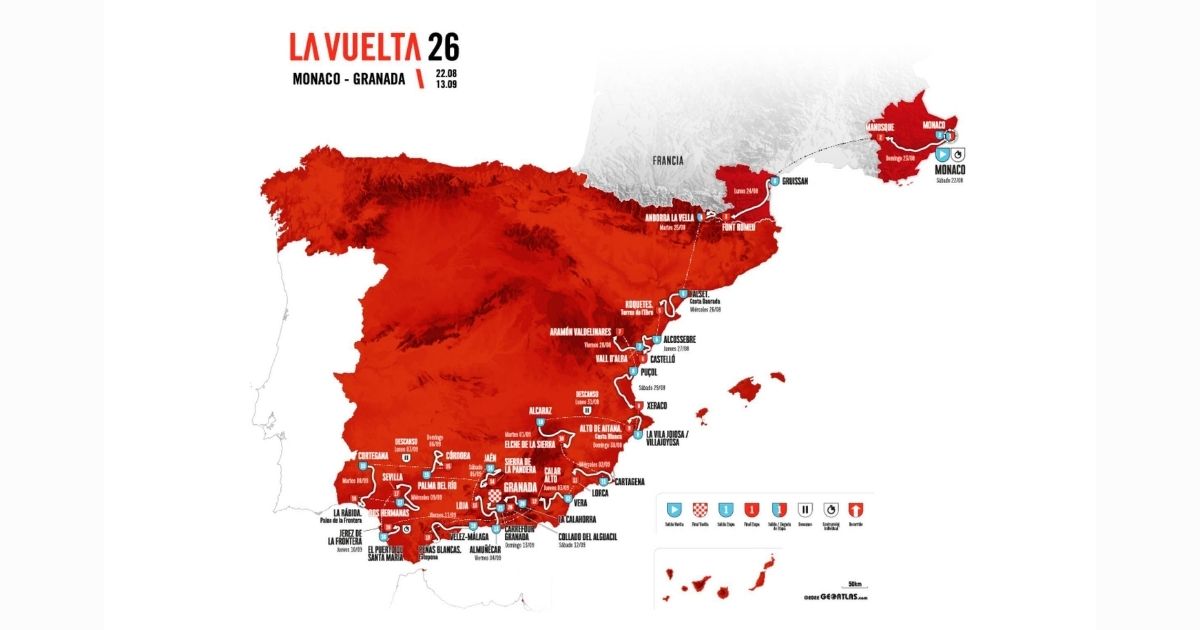
The Vuelta a España will take on a distinctly Mediterranean identity in 2026 — and nowhere will that be felt more strongly than in Andalucia. Over three demanding weeks, the race will travel from the glamour of Monaco to the historic heights of Granada, with the final ten stages unfolding entirely in southern Spain.
It is not just a change of scenery. With more than 58,000 metres of elevation gain, this is shaping up to be one of the toughest editions in the race’s history — and one designed to remain undecided until the final days.
A prestigious opening far from Spanish roads
La Vuelta 26 begins on 22 August with an individual time trial through Monaco, starting beside the iconic casino. The choice reflects the race’s growing international ambition and mirrors recent editions that have launched beyond Spain’s borders.
Monaco’s role was confirmed earlier, but the full route presentation — held in the principality and attended by Prince Albert II — revealed a race that stays close to the Mediterranean coast, crossing four countries before returning south.
Race director Javier Guillén described the route as “an edition with a very Mediterranean feel, from its start to the final stage in Andalucia”, emphasising both prestige and continuity.
France and Andorra set an early warning
As in 2025, France acts as the bridge back to the Iberian Peninsula. A sprinter-friendly finish in Manosque is followed by a tougher uphill test at Font-Romeu, before the peloton enters Andorra — a familiar but unforgiving host.
Andorra appears on the Vuelta map for the 25th time and wastes no time making an impact. Over just 104 kilometres, riders face Port d’Envalira, Beixalis, Coll d’Ordino and Alto de la Comella, a compact but brutal sequence that establishes the tone of the race.
Route designer Fernando Escartín was blunt: this Vuelta is “very tough”, with the mountains playing a starring role from the opening week.
A race designed for climbers — and survivors
In total, La Vuelta 26 includes seven high mountain stages, four medium mountain days and two time trials. Familiar uphill finishes return, but not gently.
Valdelinares reappears for the first time since 2014. Alto de Aitana returns with over 5,000 metres of elevation gain on the day. Calar Alto once again features after the Alto de Velefique, while La Pandera and Peñas Blancas revive memories of decisive battles from recent editions.
These are not nostalgic inclusions. They are deliberate stress points.
Gravel and gradients rewrite expectations
Two elements introduce genuine unpredictability.
Stage six includes a 3.5-kilometre gravel section leading to Puerto El Bartolo, marking a rare unpaved challenge in the Vuelta and forcing teams to rethink strategy.
Later, Collado del Alguacil makes its debut. Eight kilometres long, brutally steep in places and reaching gradients of up to 20%, it forms the decisive climb of stage 20 after a punishing double ascent of Alto de Hazallanas in the Sierra Nevada.
This is mountain racing with no margin for error.
Why Andalucia dominates the final act
From the middle of the race onwards, Andalucia becomes more than a backdrop — it becomes the narrative.
Ten consecutive stages take place in the region, passing through cities including Córdoba, Seville, El Puerto de Santa María and Jerez de la Frontera. A long, flat 32.5-kilometre individual time trial between El Puerto and Jerez offers a rare opportunity for specialists to recover time, contrasting sharply with the relentless climbing that follows.
Sprinters are not entirely excluded, but chances are limited. Even the final stage demands sharp legs.
Granada replaces Madrid — and makes history
For the first time since 1986, the Vuelta will not end in Madrid or Santiago de Compostela. Instead, the 81st edition concludes in Granada, with the final kilometres unfolding beneath the Alhambra.
Granada becomes only the eighth city in history to crown the overall winner of La Vuelta. The closing circuit is anything but ceremonial: riders must tackle a one-kilometre climb four times, ensuring the race remains live until the final moments.
It is a rare, symbolic finale — where sporting endurance meets cultural heritage.
A Vuelta shaped by geography, not spectacle
La Vuelta 26 is not built around a single gimmick or headline. Its difficulty comes from accumulation: altitude, heat, repeated climbing and limited recovery.
For Andalucia, the spotlight is sustained rather than symbolic. For riders, the message is clear. This is not a race you control. It is one you survive — and, if everything aligns, conquer.
Source: La Vuelta