 Lorraine Williamson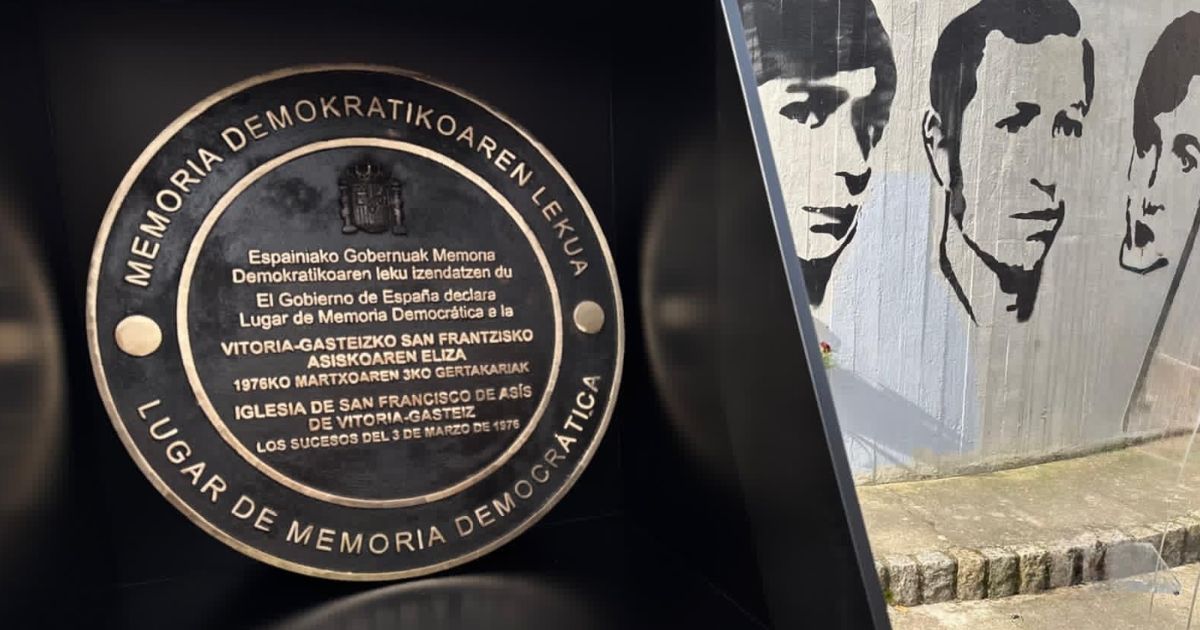
Fifty years ago today, five workers were killed in Vitoria-Gasteiz during a police operation that became one of the most notorious episodes of violence in the early transition period after Franco’s death. On 3 March 1976, thousands of striking workers had gathered inside the church of San Francisco de Asís, when police moved in to clear the building
According to multiple historical summaries and fresh anniversary reporting published today, police launched tear gas into the church and then fired as people attempted to leave, leaving five dead and dozens injured, with many wounded by gunfire.
What happened in the church in Zaramaga
The event is often referred to as the Sucesos de Vitoria (or the “3 March massacre”). The setting matters: a crowded workers’ assembly in a church in Zaramaga, a working-class district, during a period when labour rights and freedom of assembly were still heavily constrained.
For many families in the Basque Country, it has never been simply “history”. It is a lived memory of how fragile Spain’s path to democracy felt in those months — and how high the cost could be.
A first: an official condemnation from Spain’s government
This year’s anniversary has brought a significant political milestone. Spain’s government has issued an official condemnation of the police action, framing it as a disproportionate operation carried out under an administration that still carried the weight and methods of the dictatorship.
The commemoration also reinforces a wider shift in Spain’s approach to historical memory: not only recognising the victims, but placing the episode within a broader narrative of labour struggle and democratic rights.
The church is now a “Lugar de Memoria”
One concrete step has already been taken. The church of San Francisco de Asís has been officially declared a Lugar de Memoria Democrática (a recognised site of democratic memory) in a formal state decision published in Spain’s official gazette.
It is an attempt to ensure the story is not reduced to a footnote — and that future generations understand why the date still resonates.
Why the story still matters in 2026
Anniversaries can feel symbolic. But this one cuts into present-day debates: how Spain teaches its recent past, what accountability looks like decades later, and how workers’ rights were fought for in practice — not just promised in speeches.
For international residents in Spain, it’s also a reminder that many of the democratic norms now taken for granted were shaped by conflict in the street, in factories, and in places like that church in Vitoria.
A new generation at Franco memorial sparks friction in Madrid
What this anniversary changes
The condemnation and the “site of memory” designation do not rewrite the past. But they do set a clearer official record — and they strengthen the push for documentation and transparency around what happened and how decisions were made.