 Else Beekman
 Deborah Cater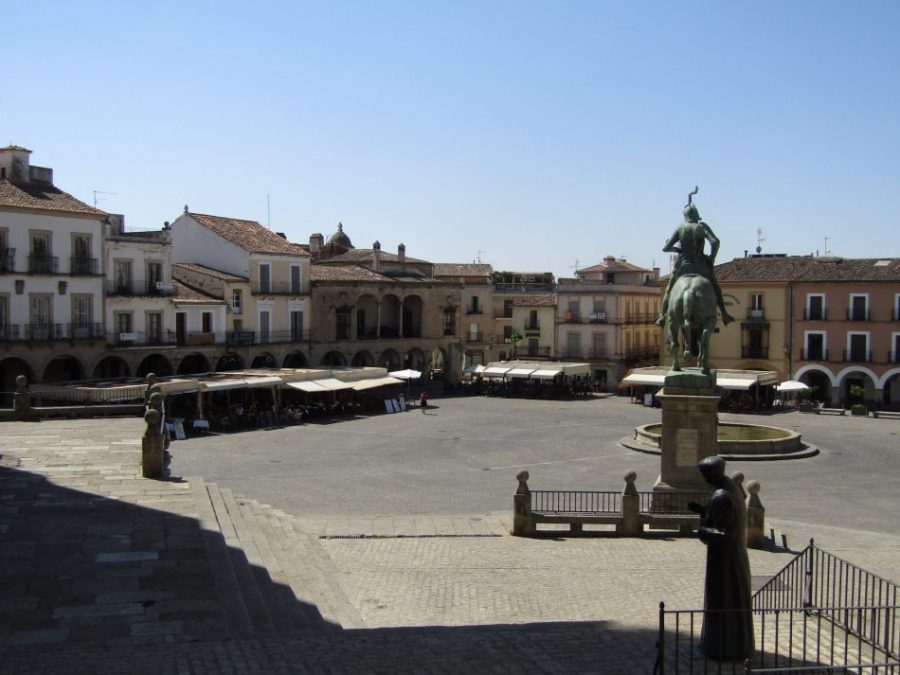
InSpain.news headed to Extremadura to discover this little-known region of Spain. This five-part series explores the region’s main towns and cities. In part 3 we head to Trujillo, home to some of Europe’s greatest explorers.
The streets to Trujillo’s Plaza Mayor are narrow and winding as they climb the hill, before opening up in the vast expanse of the main square.
This is a magical place, with the old town echoing the medieval splendour of Cáceres. Extending up the hillside, you discover mansions, courtyards shaded from the sun by fruit trees, picturesque plazas, churches and convents.
At the top is the castle from whose walls the town below and the end-of-summer dusty landscape stretched in front of you. It’s worth the climb, and along the way you can discover more the town’s history in petite museums and churches.
Plaza Mayor

As I stumbled from the shaded streets into the sunlight of Plaza Mayor, I was struck by how large it was. A fountain sits off-centre, while baroque and Renaissance stone buildings line the edges. The intricately carved facades lie beneath the storks nesting among the towers, turrets and crenelations.
At the foot of the steps to the church is a bronze equestrian statue of the conquistador Francisco Pizarro. It’s not of his time, mind you. Created by American sculptor Charles Rumsey, by all accounts it was originally a statue of Hernán Cortés. Rumsey wished to present it to Mexico. However, Mexico (understandably) not feeling particularly enthusiastic about Cortés, declined it. Hence, the statue ended up in Trujillo with Pizarro sitting astride the horse instead.
The 16th-century Palacio de la Conquista on the south side of the plaza has carved images of Pizarro and his lover Inés Yupanqui (sister of the Inca emperor Atahualpa). To the right of them is their daughter, Francisca Pizarro Yupanqui, with her husband (and uncle), Hernando Pizarro.
 The mansion, built in the 1560s, was for Hernando and Francisca; though only once Hernando re-entered society after 20 years in jail for murder. He survived to kill, unlike the other Pizarro brothers who died a bloody death in Peru. Higher up, a bas-relief carving shows the Pizarro family shield (two bears and a pine tree), the walls of Cuzco and Pizarro’s ships.
To the right of Pizarro, as you face him, is the 16th-century Iglesia de San Martín. It has wonderful striking stained-glass windows, a 1724 altarpiece and a grand 18th-century organ. Lovers of Gothic architecture will enjoy the delicate Gothic ceiling tracery in the nave.
Castillo de Trujillo

Trujillo’s castle sits on the crown of the town’s 600m-high summit. A 10th-century Islamic fortress, the Christians later strengthened it.
Walk the battlements and take in the views of surrounding landscape and the town tumbling below. The aljibe, a derelict cistern under the castle interior, is worth a peek. The hermitage of Our Lady of the Victory, Trujillo’s patron, sits in a tower. For 50 centimos, you can watch the saint spin in her alcove (apparently, it wasn’t working when I visited).
Discover the conquistadors
On the descent from the castle, I popped into Casa-Museo de Pizarro, which sits high in the upper old town. A tiny museum in a 15th-century home believed to have belonged to the Pizarro family, it has period furniture in the downstairs rooms. Upstairs, there are historical displays (in Spanish and, in parts, English) detailing the Spanish conquests in the Americas.
A more high-tech display of Spanish conquests is available at the Centro de Visitantes Los Descubridores. In the 17th-century Iglesia de la Preciosa Sangre de Cristo, it includes a timeline of the conquests, Trujillos around the world and, of course, the role of religion. There’s very little about the indigenous population of the Americas, a hefty oversight in this day and age.
Church views and crypts
The Iglesia de Santa María la Mayor is a Gothic delight. The magnificent altarpiece includes 25 brilliantly coloured 15th-century paintings by Spanish artist Fernando Gallego in the Hispano-Flemish style, depicting scenes from the lives of Mary and Christ.
Climb the 124-step Torre Julia (though she is Romanesque) and the 106-step Torre Nueva has some interesting architectural notes on the first landing. The views from either are worth the climb.
The tombs of leading Trujillo families from the Middle Ages, include that of Diego García de Paredes (1466–1533; ‘El Sansón de Extremadura’). He was a warrior endowed with awesome strength. According to Cervantes, he could stop a mill wheel with one finger.
Wander aimlessly

Always recommended when you visit somewhere new is to put the map in your back pocket and just wander. Having ticked off the biggies, I let my feet take me where they wished. There isn’t an ugly corner to Trujillo old town. Even the ruined walls have their own beauty as ivy climbs the walls between columns under a blue sky.
Once you’ve built up an appetite, there’s always the cheese.
Cheese delights
In non-pandemic years, Trujillo is the place to visit for cheesemakers and lovers. In April/May, Spain’s National Cheese Fair comes to town. However, you don’t have to wait for the annual event to enjoy some of the most unctuous cheeses out there.
I was waylaid (I was a more than willing victim) outside a cheese shop, where I sampled a variety of cheese – predominantly sheep and goat – before heading out the door with a bag of goodies. They are proud of their gastronomy in Extremadura, and rightfully so.
Back to square one

Plaza Mayor is where the locals gather in the cool of the evening to chat, the kids to play and to enjoy the local food. The square retains its function as meeting place and has a wonderful atmosphere (even in times of Covid) as the lights from restaurants, living rooms and bars illuminate the square.
Trujillo is definitely a must-see on any trip to Extremadura. Next in the Extremadura series are Badajoz and Zafra, quaint towns with rich histories. In the meantime, why not enjoy a taste of Cáceres and Mérida.


