 Lorraine Williamson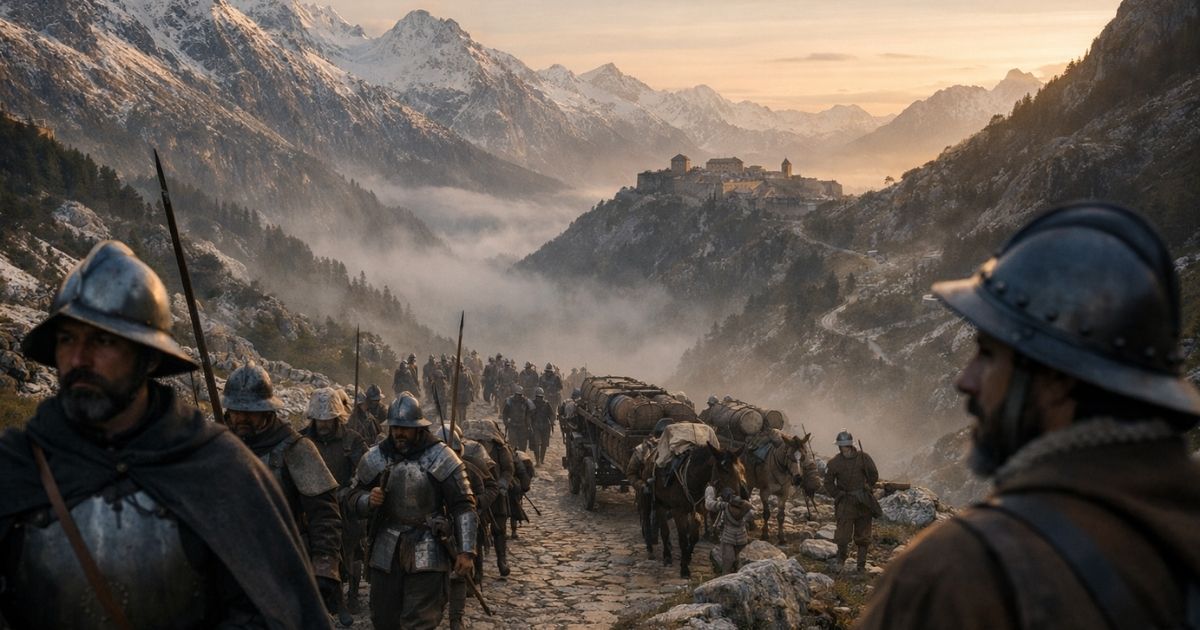
The Spanish Road to Flanders was never a single road. It was a moving, stitched-together corridor of mountain passes, river crossings, and friendly towns — a European supply chain built to keep Spain’s armies in the Low Countries fed, paid, and reinforced.
Today, the Alps are a postcard of ski stations and cycling climbs. In the late 1500s, those same ridgelines were the hard edge of strategy. If Spain couldn’t move men overland from northern Italy to the Netherlands, it couldn’t hold Flanders. And if it couldn’t hold Flanders, the monarchy’s European power began to wobble.
Historians still use the Spanish Road as shorthand for early modern geopolitics: the point where religion, trade, dynastic alliances and military logistics collided. Geoffrey Parker’s classic study frames it as the backbone of Spain’s Army of Flanders — and a measure of how organised a pre-industrial state could be when it had no alternative.
Why Madrid cared so much about a war so far away
Philip II inherited a vast Habsburg world. The Low Countries were not a distant sideshow but one of Europe’s great economic motors, and a political hinge connecting north and south. When revolt and religious conflict hardened into the Eighty Years’ War, the Spanish Crown needed a dependable way to send seasoned infantry — the feared tercios — to the front.
Sending troops by sea looked obvious. It also looked suicidal. The Channel was increasingly hostile, privateers were everywhere, and Spain’s enemies could choke maritime routes with frightening speed. Overland became the pragmatic option — slower, yes, but controllable if the right territories cooperated.
The march that proved it could be done
In 1567, the Duke of Alba led a force of about 10,000 men out of Milan and into the Alps, then on toward Brussels. It was a test run with enormous consequences: a 1,000-kilometre movement of troops across multiple jurisdictions — completed, according to widely cited accounts, in roughly 56 days.
After that, the “road” became a system. It flexed with politics: if one duke turned hostile, another corridor was opened; if one pass became dangerous, the route shifted east or west. Even the name can mislead. It wasn’t a highway. It was a map of favours, fortresses and Habsburg family ties.
123,000 soldiers — and the price of keeping the corridor open
Estimates vary by source, but the scale is clear. One widely cited figure puts around 123,000 soldiers moving along the land route between the late 1560s and the early 1600s, with far fewer making the journey by sea.
That level of movement required more than marching boots. It meant garrison towns strengthened, safe staging posts maintained, and constant negotiation with local rulers — sometimes diplomacy, sometimes pressure, often money. It was logistics as statecraft.
When Europe changed, Spain improvised
The corridor’s most famous reinvention came as wider war spread across the continent. When the Thirty Years’ War made parts of the original line riskier, Spain relied more heavily on an alternative route through the Valtellina, an Alpine valley whose religious and strategic importance made it a flashpoint.
Fortifications such as Forte di Fuentes were part of that effort — stone insurance policies meant to keep the passage open when diplomacy failed.
The collapse: war, money — and the sea turning lethal
Even a brilliant corridor can’t outpace geopolitics forever. As France moved into open conflict with Spain and pressure mounted along the Alpine approaches, the Spanish Road weakened. Once that land link failed, Spain tried to go back to sea — and paid for it.
In 1639, a Spanish fleet sheltering off the Kent coast was decisively defeated at the Battle of the Downs, a blow that helped confirm Dutch dominance in the Channel and made large-scale reinforcement by sea far harder.
The endgame followed. In 1648, the Peace of Münster formed part of the wider settlements that recognised Dutch independence, marking a turning point in the long decline of Spanish dominance in north-west Europe.
A route you can still trace today
What’s striking is how much of the corridor remains legible. Parts of the old line from Milan toward Brussels can still be followed — by car in places, by bike and on foot in others — not as a single signed trail, but as a chain of landscapes that still carry the imprint of frontier Europe.
In Spain, there is renewed interest in promoting the shared heritage of the Camino Español, with an association dedicated to researching and publicising the route’s story and its European legacy.
Europe’s forgotten motorway is back on the map
The Spanish Road to Flanders is a reminder that empires rarely fall only because of battles. Sometimes they falter because the connective tissue fails — a pass closes, an ally shifts sides, the money runs out, the sea becomes hostile.
And sometimes the most revealing history is the kind you can still walk: a valley that once mattered because it was Catholic, a fortress built to intimidate a border, a town that thrived because soldiers had to eat somewhere. The road has gone. The logic that built it — power depends on supply lines — hasn’t changed.