 Lorraine Williamson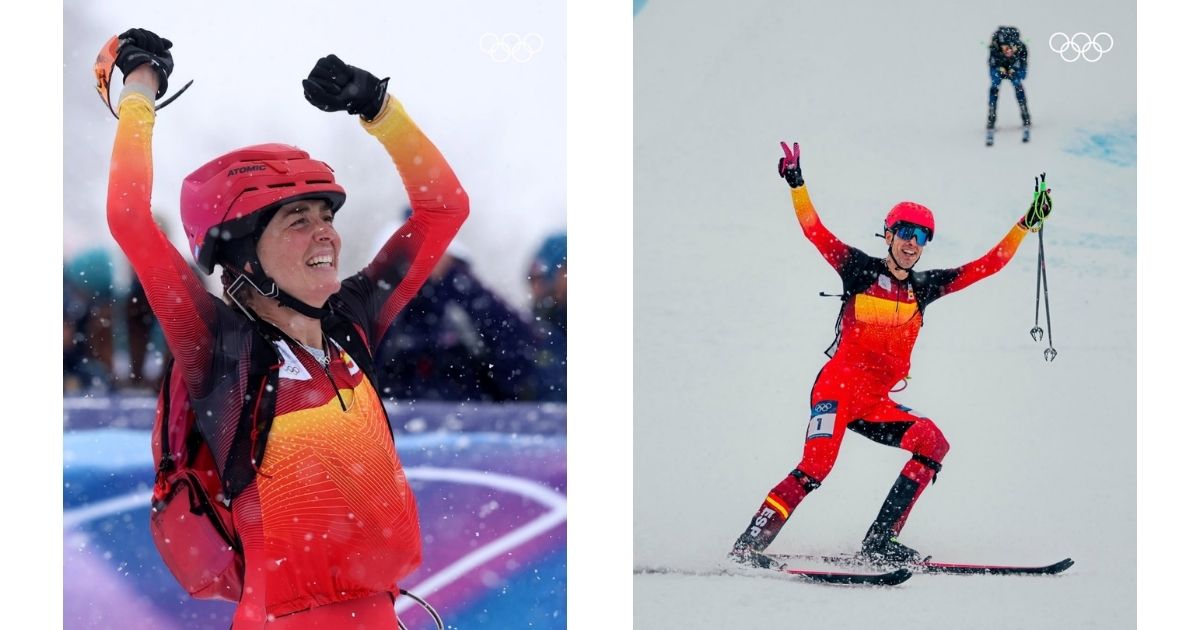
Spain’s best-ever Winter Olympics didn’t arrive through alpine skiing’s old pathways or an explosion of snow culture. It arrived through ski mountaineering — skimo — the new Olympic discipline that looks tailor-made for a country built around rugged ranges rather than endless winter plains.
At Milan-Cortina 2026, Spain left with three medals in the sport’s Olympic debut: one gold and two bronze. It was the biggest single-Games medal haul Spain has ever managed at the Winter Olympics.
Why skimo clicked when other winter sports didn’t
Skimo rewards efficiency on steep ground. Athletes climb hard on lightweight skis with skins, rip them off at transitions, then descend fast on technical terrain. It’s a sport of oxygen debt and split-second changeovers, as much mountain running as skiing.
That matters for Spain. The country doesn’t have the depth of resort systems seen in the Alps or Scandinavia, but it does have serious mountain environments. The Pyrenees and Sierra Nevada offer the altitude and gradients skimo athletes need — and, crucially, a culture of endurance sport that transfers well. (This is the “fit” story: the sport matches the landscape, not the other way round.)
Cardona’s gold and the end of a 54-year wait
The headline moment was Oriol Cardona Coll winning men’s sprint gold, which Reuters described as Spain’s first Winter Olympic gold in 54 years, since 1972.
The number is stark. Winter medals in Spain have tended to arrive as rare peaks, followed by long silences. Cardona’s win didn’t just add a medal — it snapped a narrative.
Ana Alonso’s two bronzes and the relay drama
Spain’s breakthrough wasn’t a one-off. Ana Alonso Rodríguez took bronze in the women’s sprint, then returned with Cardona to claim bronze in the mixed relay.
That relay medal came with tension: Spanish coverage highlighted a small time penalty after an incident, yet Spain still held onto third.
Spain arrived in Milan–Cortina with a winter medal record built on rare, standout moments rather than sustained runs. The first came in 1972, when Francisco Fernández Ochoa won slalom gold. His sister Blanca added a bronze in 1992.
After that, Spain waited a long time for the next podiums. Regino Hernández and figure skater Javier Fernández both took bronze in 2018, before snowboarder Queralt Castellet claimed silver in 2022. With those five medals as the backdrop, the three skimo podiums in 2026 lift Spain’s all-time Winter Olympic total to eight.
What these medals really say about Spain’s winter future
Eight medals across nine decades will never look huge beside the winter superpowers. But skimo suggests a smarter way for Spain to compete: specialise in disciplines that match its geography, build elite programmes around fewer athletes, and keep investment focused rather than symbolic.
Spain’s sports authorities are already framing Milan-Cortina as a best-ever performance and a platform to build on.
A closing thought for Spain’s next cycle
If Spain treats these Spain skimo Olympic medals as a blueprint — not a once-in-a-generation fluke — the country’s winter story could finally shift from occasional miracles to something closer to a system.