 Lorraine Williamson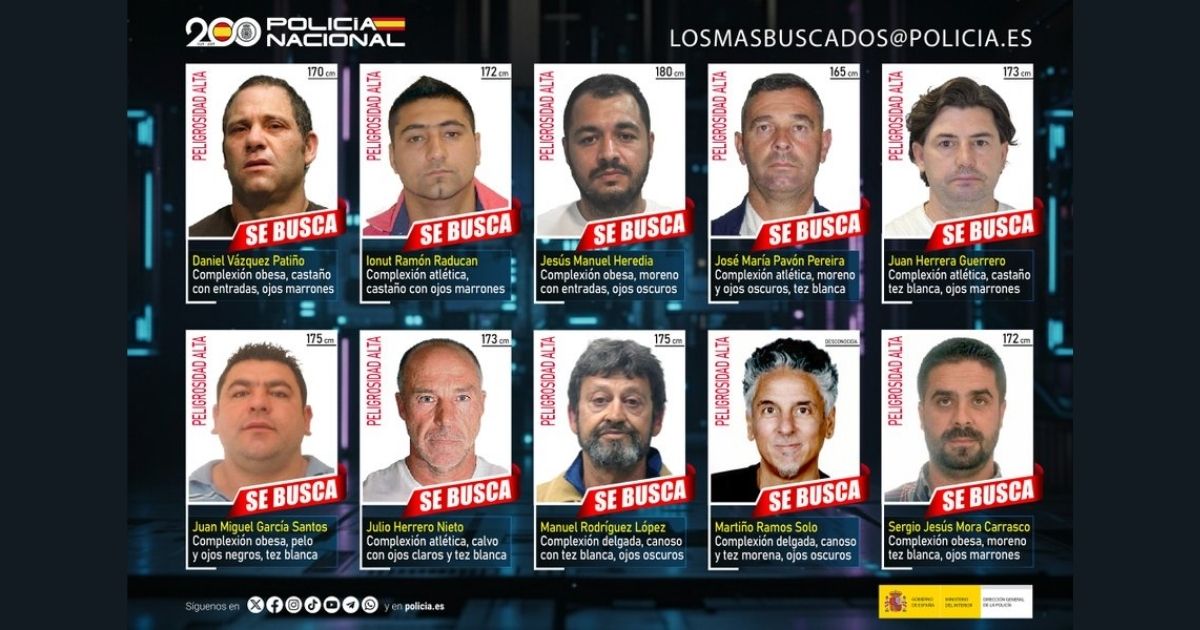
How close could you be to someone on Spain’s most wanted fugitives list without knowing it? That unsettling question sits at the heart of a renewed national alert issued by the Policía Nacional, who warn that ten high-risk criminals may be moving through Spanish cities, towns and transport hubs unnoticed. The police have taken the unusual step of releasing not only real photographs but also AI-generated reconstructions. These show how these individuals could look today if they have altered their appearance.
The call for citizen assistance is not symbolic. Investigators say public vigilance is now one of the most important tools available to track dangerous fugitives. Particularly those involved in sexual violence against minors, murder, human trafficking, large-scale narcotics operations and violent robberies. Each case carries a history of evasion, and several fugitives have spent years, even decades, refining their ability to disappear.
In an age when offenders can change their appearance, exploit cross-border loopholes or hide within transient industries, Spain is adapting its approach. The aim of the latest appeal is clear: make their faces impossible to forget.
A national alert rooted in urgency
The updated list brings together men linked to what the police categorise as delitos de especial gravedad. These are among the most serious crimes recognised under Spanish law: murder, sexual assault of minors, drug trafficking, human trafficking and violent robbery involving weapons. The label attached to all ten men is unequivocal — every one of them is considered altamente peligroso.
For the officers leading the manhunt, the reissued alert reflects a growing reality. Fugitives no longer simply flee to remote countryside enclaves or isolated border towns. Many blend into city life, hold casual jobs, use public transport and live in rented accommodation paid in cash. Others rely on extended criminal networks that offer shelter, forged documents or transport across borders within hours.
This is why the police insist that even the smallest detail from the public — a passing resemblance in a café, a neighbour who suddenly avoids eye contact, a man whose appearance matches a reconstructed image — could help break open a case. All information can be shared confidentially with investigators at the dedicated address losmasbuscados@policia.es a channel created specifically for this operation.
460 fugitive arrests in a year — and the system behind it
Behind the alert is Spain’s specialist fugitive-tracking infrastructure, which has expanded rapidly over the past decade. In 2024 alone, teams involved in national and international searches detained 460 fugitives wanted for crimes across different jurisdictions.
The system is built on two pillars: Spain’s own Sección de Localización de Fugitivos, responsible for coordinating nationwide searches, and ENFAST, the European Network of Fugitive Active Search Teams. ENFAST operates on a permanent 24/7 basis, providing immediate cross-border communication between police forces. A sighting in France, Portugal, Belgium or the Netherlands can trigger real-time action, allowing teams to move within immediately.
For fugitives involved in drug trafficking or human exploitation, the EU’s integrated policing framework poses growing challenges. Criminals, once confident they could vanish into other European states, now face a network designed to follow them across airports, ports, motorways and rail links.
How fugitives evade capture — and why this list matters
Spain’s geography makes it both accessible and difficult to police. Long coastlines, busy ports, rural interiors and shifting migrant routes give fugitives multiple avenues to move unnoticed. The Campo de Gibraltar, Galicia’s Rías Baixas and the industrial belt of Madrid each have distinct criminal landscapes that can shelter individuals with the right contacts.
Drug traffickers, for example, often rely on maritime routes. Multi-tonne shipments of hashish or cocaine arrive on fast boats along the Andalucian coast. Meanwhile, containers moving through Atlantic ports may conceal smaller loads hidden inside agricultural products. These same logistics can be repurposed to move people, money or fugitives themselves.
Offenders convicted of crimes against minors often follow a different pattern. Some avoid digital footprints entirely; others move between short-term rentals and informal jobs. Police believe that several individuals on the list still maintain ties to regions where they once lived or worked. Moreover, this makes local vigilance essential.
The renewed alert is designed to push these hidden presences into public consciousness.
Crimes against children: the darkest cases on the list
Among the most urgent cases are those involving crimes against minors. This is a category that Spanish investigators treat as an absolute priority.
One of the most disturbing files is that of Martiño Ramos Soto, a former teacher from Ourense, sentenced to 13 years in prison for the prolonged and sadistic abuse of a pupil aged between 12 and 16. His role as an educator allowed him to conceal patterns of coercion and manipulation over several years. Police consider him highly dangerous, and his ability to blend into smaller communities remains a concern.
Daniel Vázquez Patiño, from A Coruña, is wanted for the sexual assault of a ten-year-old girl. Authorities believe he may still be circulating within northern Spain, where he maintained professional and social ties before fleeing justice.
Meanwhile, Juan Herrera Guerrero, from Puente Genil in Córdoba, is sought for multiple assaults on minors. Investigators warn he may change his appearance using simple, effective techniques, including using prescription glasses to alter his profile.
These cases represent a wider issue in Spain. Offenders who commit sexual crimes against minors often live double lives, sometimes appearing integrated within their communities. Moreover, the police list is a reminder of how critical vigilance is in preventing further harm.
Murder and extreme violence: a risk beyond evasion
The list also includes José María Pavón Pereira, convicted of a double murder in Granada carried out with extreme cruelty. He received a 41-year sentence and is considered one of the most dangerous men currently at large.
Cases like his illustrate a particular policing challenge. Individuals convicted of violent murders may flee not only to avoid imprisonment but also because they remain unpredictable and volatile. Their presence in any community represents a high-level public safety risk. Consequently, police continue to treat these files as active threats rather than historical crimes.
The hidden world of human trafficking
Spain’s position as a gateway between Europe and Africa makes it a major target for trafficking networks, especially those exploiting vulnerable women and minors.
One of the most troubling fugitives on the list is Ionut Ramon Raducan, known as “Florin”, convicted of forcing both his younger sister and his partner into prostitution in Madrid’s Marconi industrial zone. His case reveals the layers of coercion and violence that underpin trafficking operations: psychological control, threats of retribution, and the exploitation of family relationships.
Trafficking networks often use industrial areas, logistics hubs or motorway corridors to move victims. Police warn fugitives involved in such crimes may appear in areas with high turnover of temporary labour or transport services.
Armed robbery and escalating violence
The profile of Manuel Rodríguez López, a Barcelona native, fits another pattern familiar to investigators. He is a long criminal career marked by repeated offences, prison escapes and illegal weapons possession. Individuals like him, who combine experience with unpredictability, pose complex challenges for law enforcement and tend to move frequently between regions.
For police, capturing repeat violent offenders is vital to preventing spirals of escalating attacks, especially when weapons are involved.
Drug trafficking: the backbone of Spain’s fugitive networks
Half of the men on the list have links to major narcotics operations, an area where Spain serves as both a gateway and a battleground. The routes stretching from Morocco to Andalucia, from Latin America to Galicia, and from Portugal into western Spain form the backbone of Europe’s drug supply chains.
Jesús Manuel Heredia, alias “El Pantoja”, from Algeciras, is one of the most well-known names in the world of hashish trafficking. As leader of the “Los Pantoja” clan, he is tied to the Campo de Gibraltar, a region where smuggling has created a parallel economy and frequent clashes between criminal groups and law enforcement. His association with Abdellah El Haj, the so-called “Messi of hashish”, adds another layer to his notoriety.
Also on the list is Sergio Jesús Mora Carrasco, known as “Yeyo”, regarded by investigators as one of Europe’s major hashish traffickers. His speciality lies in maritime transport using high-speed boats capable of outrunning patrol vessels. His operations often span both sides of the Strait of Gibraltar.
From the north, Juan Miguel García Santos, from Vilanova de Arousa, is sought for masterminding a cocaine route using banana shipments from Ecuador. Galicia’s inlets and coastal atmosphere have historically made the region a haven for smuggling networks.
Completing the narcotics-related cases is Julio Herrera Nieto, accused of supplying heroin and cocaine to distributors across the Plasencia region. Authorities consider him armed and dangerous due to his association with illegal firearms.
AI technology and the evolution of public appeals
One of the most striking features of this year’s appeal is the use of AI-generated images. Real photographs have been paired with reconstructions that simulate natural ageing, weight changes, haircuts or facial hair variations.
The goal is not only to refresh public memory but to anticipate the strategies fugitives often use when hiding in busy urban environments. These tools reflect a broader trend in European policing, where artificial intelligence is increasingly applied to surveillance, border checks and identity fraud.
For the public, AI reconstructions serve a simple purpose: even if a fugitive has altered their appearance, you may still recognise a distinctive feature, posture or expression.
The public’s role — and why every detail matters
Some of Spain’s most significant fugitive arrests in recent years began with an ordinary person spotting something unusual: a man who avoided showing his face in communal areas, an individual who resembled a reconstructed image more than the original photo, or a neighbour whose habits didn’t align with his supposed identity.
This is why the Policía Nacional repeatedly emphasises the same message: sightings should be reported, but members of the public must never approach or confront a suspect. Everything — from a location and time to a description of clothing or behaviour — can help investigators narrow their search.
Confidential information can be sent at any time to losmasbuscados@policia.es with full anonymity guaranteed.
A long battle that depends on public vigilance
The ten men highlighted in this renewed search represent broader challenges facing Spain and Europe: transnational crime, child exploitation, drug cartels, trafficking networks and escalating violence. Each case tells a story of individuals who have used deception, mobility and criminal support systems to evade justice.
Yet the police insist that their arrest is possible — and that the combined power of updated technology, international cooperation and public alertness offers the best chance of closing these files.
Spain’s most wanted fugitives are not ghosts. They travel, they shop, they move among crowds. That is why the renewed appeal matters, and why authorities believe that public awareness, more than anything else, could turn the tide.