 Else Beekman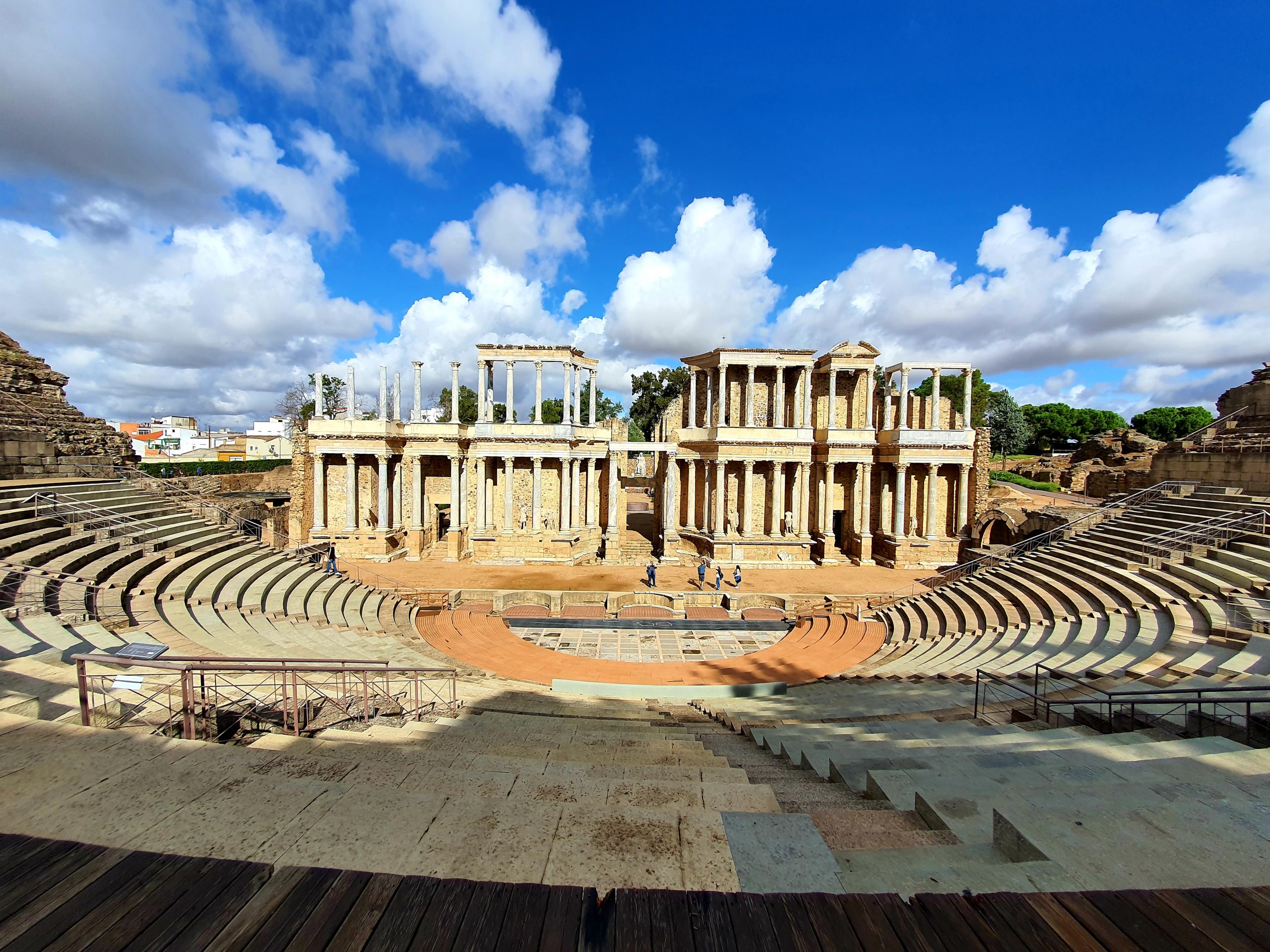
InSpain.news headed to Extremadura to discover this little-known region of Spain. This five-part series explores the region’s main towns and cities. Today, we head to Mérida, simply bursting with some of the most important Roman remains in Europe.
Having driven through torrential rain in Seville on my way to Extremadura, the gods (Roman?) were smiling on me when I reached the region’s capital, Mérida.
The most impressive Roman ruins in Spain are dotted among this lively town. Turn a corner and you could be confronted with the remains of a temple. Aside from the incredible Roman history, the UNESCO World Heritage Site is modern with a great social scene and relaxed atmosphere. Enjoying an inter-lockdown break here was just the tonic.
Capital of Ancient Lusitania
In 25BC, the Roman Emperor Augustus founded the city Emerita Augusta for veterans of his army. Mérida is a derivation of the original name. Emerita Augusta was at one of the Vía de la Plata (Silver Way), a strategic route between the gold mines around Asturica Augusta and the most important Roman city in the Iberian Peninsula. Mérida went on to become the capital of Lusitania province, and one of the most important cities in the Roman Empire.
Even after passing into the hands of Visigoths and Moors, then experiencing the Christian reconquest, it was Napoleon’s 19th century invasion of Spain that saw most of the city’s monuments destroyed.

Luckily, that still leaves a lot to see. While there are tonnes of Roman ruins to visit, the town also has the spacious Plaza de España which harks back to medieval times, and now boasts facades from across the centuries. The Palace of the Mendoza and the House of The Pacheco interesting architectural features dating from the 15th century to a neo-Mudejar courtyard from the beginning of the 20th century, respectively.
Theatre and Amphitheatre
Possibly the most impressive of the Roman ruins are the theatre and amphitheatre. I made them my first port of call. When tourism season is fully underway, it is best to get there early so you can take photos of these wonderful constructions without a gaggle of tourists blocking the view.
A teasing view of the theatre is provided as the path winds first to the amphitheatre. Built in 8 BC, it was the setting for very popular shows: gladiators, wild beast hunts, and the struggle between wild animals in artificial settings. They recreated forests, jungles with lakes and or deserts – all on top the wooden platform that was known as the arena. Approximately 15,000 to 16,000 spectators could watch the spectacles.

From the amphitheatre, it’s a short stroll to the theatre. Built 7 or 8 years earlier than the amphitheatre, it could seat up to 6,000 spectators. It is an impressive building, with the Corinthian columns of the porticus post scaenam (frons frons) rising in front of you. The columns support richly decorated friezes and statues. A large marble wall encloses the back of the stage scaenae frons beyond which is a pretty garden.
Martyrs and Miracles
Skirting the centre of the town, are two sites that contribute to Mérida’s historical tapestry. The Basilica de Santa Eulalia incorporates Roman, Visigoth and 17th tombs and artwork and is the site of the Eulalia’s martyrdom. According to legend, having insulted the Roman gods, emperor and anyone else she could think of, soldiers stripped Eulalia, tortured her with hooks and torches, and burned her at the stake. As she died, a dove flew out of her mouth and a miraculous snow covered her nakedness. The purity of the white snow indicated her saintliness.
 From religious to architectural marvel, and moving slightly further away from the town centre, is the Acueducto de los Milagros. A park with running/cycle paths surrounds the aqueduct, which it transpires is a popular place for communion photos. Lots of young girls in beautiful white dresses and boys looking smart in their suits, posed in front of the remaining 38 arched pillars standing 25 metres high.
One of three aqueducts built by the Romans, later inhabitants of Mérida dubbed it the “Miraculous Aqueduct” for the awe that it evoked. Close by, a small Roman bridge called Puente de Albarregas runs parallel to the arcades.
Beef it up
Extremadura’s meat is renowned, and it’s not just the jamón Iberíco. The Denomination of Origin (DO) Ternera de Extremadura includes six regional cattle breeds (such as the highly regarded retinta) and two further breed crossings.
The beef is delicious. I tried it at Casa Benito, in the form of a tasty burger washed down with delightful Extremadura wine. Situated next to the market in the centre of the town, the restaurant is a bullfighter enthusiast’s hangout, with a terrace, bar and upstairs restaurant. However, for me it is the taste of the meat, and you can tell the animals have been dining on good pasture.
In fact, 1,800,000ha of Extremadura’s territory (43%) is pasture, just over half of which is wooded pasture. The ecosystem also supports grasses, acorns, cereal, charcoal, cork and grains.
Spanning history

You need a filling meal to build up the energy for exploring the rest of Mérida. At the river Guadiana, there’s Puente Romana, the world’s longest (distance) surviving bridge from ancient times. At one time it had 62 spans, with a length estimated at 755 m. Now there are 60 spans (three buried on the southern bank), and a length of 721 m between the abutments. The bridge is for pedestrians only nowadays. But do cross over as you’ll get a great view of the Alcazaba from the opposite bank.

Built by emir Abd ar-Rahman II of Córdoba in 835, the Alcazaba was the first Muslim fortress. It is a big square of walls, every side measuring 130 metres in length, 10 m of height and 2.7 m thickness. The Moors built it re-using Roman walls and Roman-Visigothic edifices in granite.
The views from the walls are fantastic, stretching along the river. In the centre of the fortress is the Roman water cistern. You can enter the building and go down cobbled steps to the cistern itself with its barrel vault roof.
Uncovering the past

The past is pretty much in plain sight in the centre of Mérida. My accommodation was 20 metres form the Temple of Diana, standing tall in a small plaza. However, there is still excavation work going on at the Casa del Mitreo, on the outskirts of the city centre. Walking past the Alcazaba, the site sits between the busy main road and the bullring, but inside are treasures.

The villa belonged to an important family and inside archaeologists discovered remains related to the cult of Mitra. Hence the villa’s name. Looking into the villa’s rooms you see very high-quality mosaics and mural paintings. The most important mosaic is the cosmic one which represents heaven, earth and the sea.
Adjoining the villa is a Roman cemetery with the mausoleum of important families, the Voconios and the Julios. And all this less than half a kilometre from where we started at the amphitheatre.


Next in the Extremadura series is Trujillo, a medieval town of explorers and conquistadors. In the meantime, why not enjoy a taste of Cáceres.