 Lorraine Williamson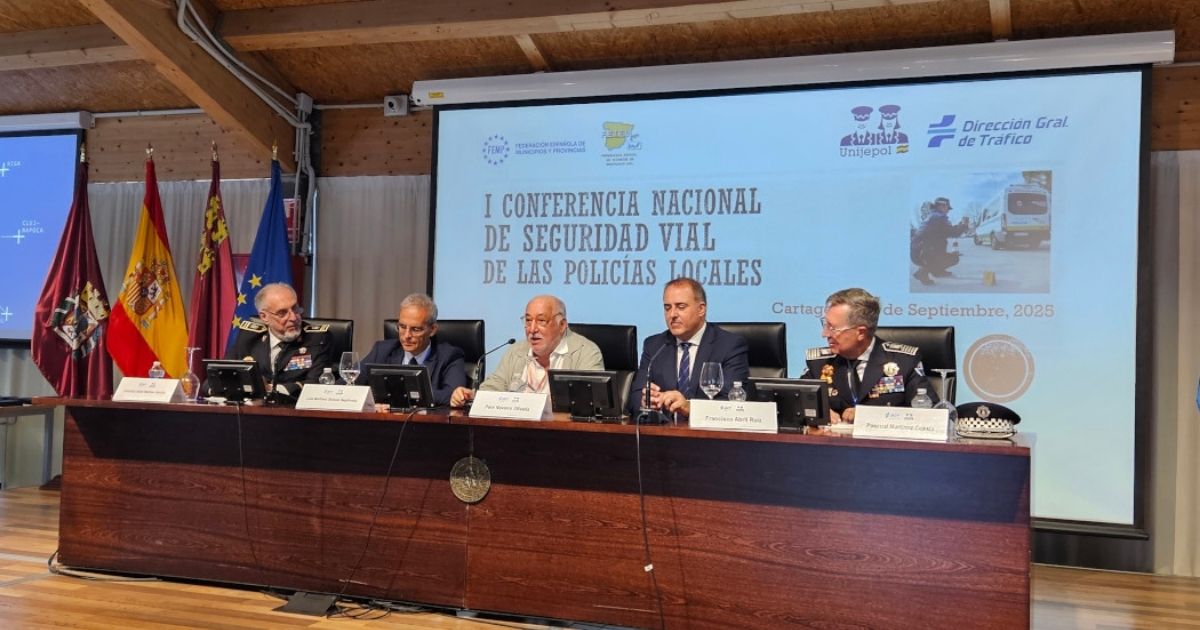
Cartagena has become the focal point of Spain’s push for safer city travel as traffic experts, local police chiefs, and government representatives gather for the country’s first National Conference on Road Safety for Local Police. Hosted by the Polytechnic University of Cartagena, the meeting forms part of Spain’s ambitious Road Safety Strategy 2030 and aims to confront the daily challenges of keeping urban streets safe for everyone.
The event highlights the critical role of Spain’s 70,000 local police officers operating across 1,700 municipalities. Their work spans traffic control, accident response, and community education—tasks that, according to the Spanish Federation of Municipalities and Provinces (FEMP), make them “true guardians of urban safety.”
30 km/h speed limits show results
Spain’s Director General of Traffic, Pere Navarro, used the opening session to underline how the 30 km/h speed cap on urban roads and broader traffic-calming measures have sharply reduced accidents and saved lives. “When mobility is ordered, safety follows,” Navarro said, stressing that lower limits protect the most vulnerable users—pedestrians, cyclists, and e-scooter riders.
Navarro praised local police for balancing education and enforcement. Officers not only patrol streets but also teach road safety in schools and cultural centres, bridging the gap between awareness campaigns and real-world compliance.
Speeding fines on the rise in Spain
Cities urged to treat safety as a right
FEMP secretary general Luis Martínez Sicluna called safe mobility “an ethical duty, not a statistic,” urging municipalities to expand bike lanes, improve signage, and invest in safer street design. He argued that the future of Spanish cities depends on making roads secure for all users, framing mobility not just as a transport issue but as a matter of public health and civil rights.
Building consensus across institutions
For Pascual Martínez, president of the national association of local police chiefs (Unijepol), the Cartagena forum offers a rare chance for officers and the national traffic authority to share frontline concerns and refine strategy. “Spaces like this help align criteria, share experiences, and move towards more effective, citizen-focused management,” he said.
Álvaro Gómez, head of the DGT’s National Road Safety Observatory, presented data showing 488 urban road deaths in 2024—a 6% drop on the previous year. Nearly eight in ten victims were classified as vulnerable users. Gómez welcomed the decline but warned it remains “a hopeful yet insufficient figure” that demands further joint action.
Good practice guide and next steps
Delegates also unveiled a new Good Practice Guide to help municipal police improve accident investigation, enforce updated regulations and integrate sustainable transport plans. Panel sessions throughout the day are tackling subjects from emerging crash-analysis techniques to the impact of e-mobility on city planning.
The conference signals a decisive step in Spain’s Vision Zero journey. With local police at the forefront, the message from Cartagena is clear: safe urban mobility is not just a goal—it is a shared responsibility that shapes the future liveability of Spain’s cities.