 Lorraine Williamson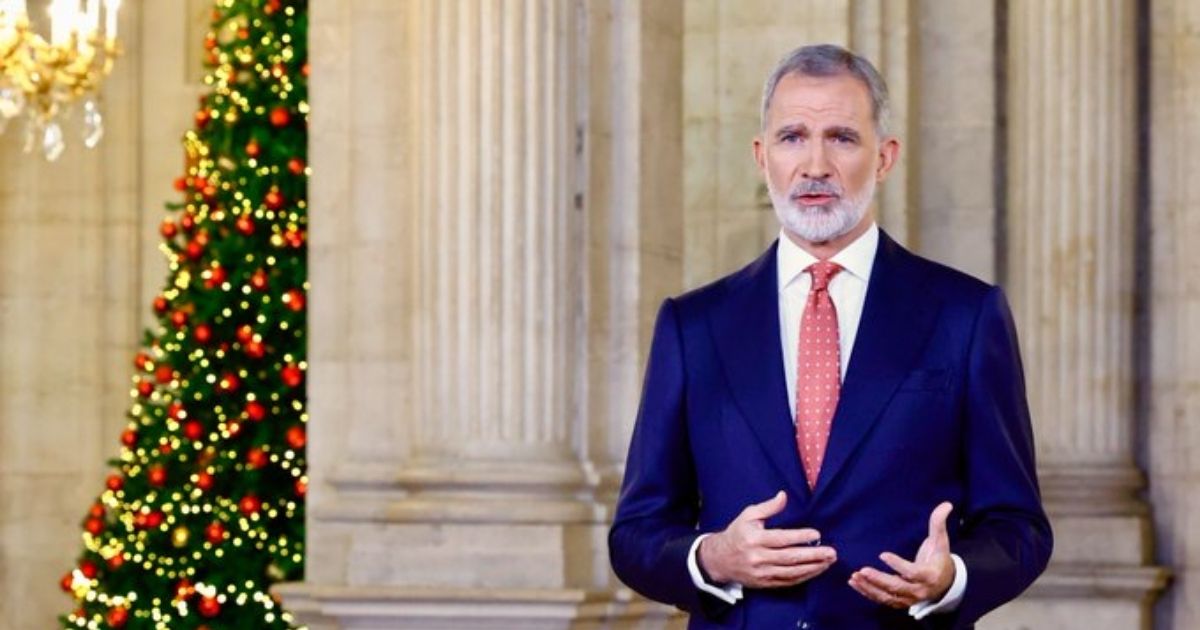
For one night each December, Spain’s politics pauses just long enough to listen to the King. Not to a programme, or a pledge, but to a carefully built statement of values — the sort that tries to hover above party battles, even when the country below is shouting. This year, Felipe VI chose to speak from the Salón de Columnas in Madrid’s Royal Palace, marking two anniversaries at once: 40 years since Spain signed the treaty that took it into the European project, and 50 years since the start of the democratic Transition.
The staging mattered. Felipe delivered the address standing up, for the first time, in what Spanish media described as his briefest Christmas message since taking the throne. El País+1 That change in posture did not make it a more political speech. If anything, it underlined the point: this was a speech about the framework — the boundaries — rather than the daily trench warfare.
Yet, in a country where language is read like a map, neutrality never feels neutral. What the King chose to underline, and what he chose not to name, quickly became the real story.
Two anniversaries, one argument: living together
Felipe’s core theme was convivencia democrática — democratic coexistence — anchored in memory. He returned to the Transition not as nostalgia, but as a lesson in method: responsibility, dialogue, compromise, and a shared will to build something bigger than faction.
He also framed Spain’s EU path as a democratic milestone, not merely an economic one. Europe, in his telling, helped lock in liberties and modernisation. In a year when “Europe” is often used as either a shield or a stick in domestic debate, the King made it sound like a common inheritance — something to protect, not weaponise.
That historical framing did a subtle job. It invited the audience to step back from the headlines and ask a different question: not “who’s winning?”, but “what are we risking if we keep tearing at the seams?”
Where the King got more specific than critics admit
A familiar criticism of royal Christmas speeches is that they float above real life. This year, Felipe quietly tried to ground his message in everyday pressure.
He spoke of the rising cost of living, of housing access becoming an obstacle for young people, of technological change feeding job insecurity, and of climate events increasingly shaping — and sometimes tragically disrupting — lives. These were not detailed policy points, but they were recognisable realities, threaded into a wider argument about social strain.
He also acknowledged the mood music: fatigue with politics, disaffection, and the sense that problems will not be solved by rhetoric alone.
In other words, the King did not pretend Spain was cruising. He described a country under pressure, then asked what holds it together when pressure rises.
The warning at the centre: mistrust is a gateway drug
The sharpest line in the speech was not a name, but a diagnosis.
Felipe warned of a crisis of trust in democratic societies, aggravated by disinformation and inequality, and argued that this is where extremism, radicalism and populism thrive. The language was broad enough to avoid pointing a finger, but pointed enough to land.
He paired that warning with a set of behavioural demands that sounded almost like a civic checklist: dialogue, respectful language, listening to others, and “exemplary” conduct from public institutions. Empathy and human dignity — particularly for the most vulnerable — were placed at the centre of public life, at least as an aspiration.
And he offered one of the night’s most quoted thoughts: in a democracy, “our own ideas should never be dogmas” and other people’s ideas should not be treated as threats.
It was, unmistakably, a speech about tone. About the social cost of permanent outrage. About the way politics can harden into identity, and identity into hostility.
What he left unsaid — and why that still mattered
Even with those nods to cost of living and housing, the King avoided the granular list of issues dominating daily debate.
He spoke of a world order in crisis, yet did not name specific conflicts. He warned about climate-related tragedy, but did not move into the highly charged territory of blame, responsibility, or urgent political trade-offs. Then he talked about distrust in institutions without walking into the minefield of naming scandals, court cases, or particular political flashpoints.
This is always the logic of the constitutional monarch: protect the shared floor, do not join the fight on it. Supporters argue that once the King starts itemising controversies, he stops being a reference point and becomes another combatant.
Critics see something else. They hear a speech that urges everyone to calm down, without fully acknowledging how unequal, precarious, or angry daily life can feel — or why some voters are drawn to sharper, simpler answers.
The reactions were divided — and entirely predictable
Within hours, political responses formed the usual pattern.
Spanish media reported broad backing from the PP and PSOE, with praise for the appeal to coexistence and institutional responsibility. Meanwhile, Sumar voiced disappointment, and Podemos and several nationalist and independence parties criticised the message from a distance they have never tried to hide. That split is not an accident of tone; it is the ecosystem the speech lands in. The King can speak in general principles, but Spain hears him through politics.
A speech designed to be argued over
Felipe VI did not deliver a manifesto. He delivered a frame.
By putting trust, language, and democratic coexistence at the centre — and by warning how quickly those things can erode — he offered a kind of national safety briefing. casareal.es+1 It was also a reminder of how fragile the Transition’s social bargain can feel, 50 years on, when daily life is expensive, housing feels out of reach, and politics resembles a permanent street argument.
What he said mattered. What he did not name created the debate around it. In Spain, that is often the point: the King rarely settles arguments — but he can still set the terms in which the arguments happen.