 Lorraine Williamson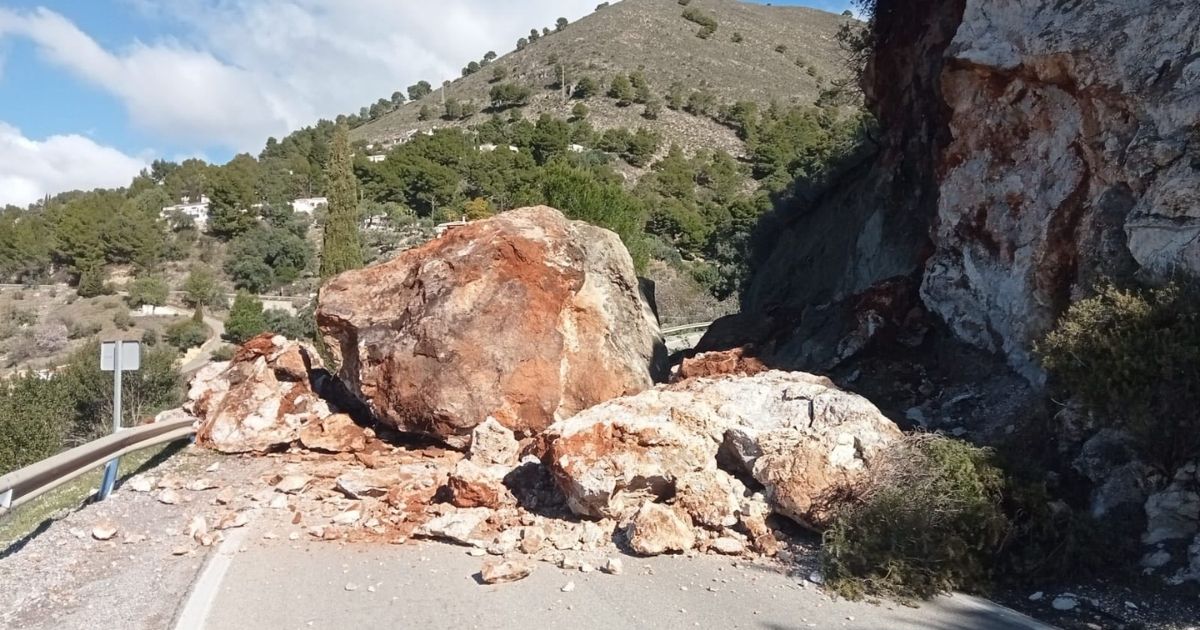
A single boulder shouldn’t be able to cut a village off. Yet on Saturday, Cómpeta — one of the Axarquía’s best-known mountain towns — found itself close to being effectively stranded when a major rockfall blocked a key road link and left drivers relying on long, twisting alternatives.
The incident is a reminder that even when the skies clear, the real impact of extreme rainfall can arrive later — as saturated slopes shift, drainage fails, and narrow road networks become the weak point for communities perched above the coast.
What happened on the A-7207
On 14 February, a rockfall forced the closure of the A-7207, the road that connects Cómpeta with the coastal side of the Axarquía via Torrox. Local authorities said large rocks came down onto the carriageway, blocking passage and triggering an immediate traffic stop while crews assessed the risk.
According to municipal sources quoted by EFE, there were no injuries, and maintenance teams were sent to evaluate damage, remove debris and confirm the stability of the slope before reopening.
Why this rockfall hit harder than usual
The timing was the problem. The closure on the A-7207 came while another main access route was already affected: the A-7206, linking Cómpeta with Sayalonga, had been subject to a preventive cut and repair works from kilometre 6, according to a notice shared by the local council.
When two routes are compromised within days of each other, the impact isn’t just “inconvenience”. It becomes a question of access for emergency services, supply deliveries, work commutes, and travel plans that often depend on tight timings to and from the coast or airport.
Overnight repairs — and a rapid reopening
Work crews moved quickly. By early Sunday, the A-7207 had reopened after intensive efforts to remove the fallen rock, with local reporting describing a long night of heavy machinery and coordination. The mayor, quoted locally, urged continued caution because further slope movement cannot be ruled out.
Málaga Hoy also reported the closure and attributed the incident to the lingering effects of recent downpours, underlining that the damage is consistent with hillsides remaining unstable after prolonged rain.
The bigger story: mountain links under pressure
In the Axarquía, villages are connected by a web of steep, narrow roads carved into hillsides that were never designed for today’s traffic volumes — or for a climate that increasingly delivers heavy rain in intense bursts.
When the ground is saturated, a slope can give way long after the rain has stopped. That’s why residents often find the “danger window” doesn’t end when the forecast improves. It shifts from flash flooding to rockfalls, subsidence and road-edge failures.
The practical vulnerability is structural: if one road goes down, there often isn’t a fast, high-capacity substitute. Detours exist, but they tend to be slower and more demanding — exactly the conditions that make routine travel stressful and emergency response more complicated.
How the village kept moving: rapid updates and local coordination
One striking feature of incidents like this is how quickly information now circulates. In towns where municipal updates, local radio and community groups move in minutes, residents can redirect travel and share safe alternatives before congestion builds.
That speed matters when closures happen on a weekend, when travel volume is high, and many journeys are time-sensitive. It doesn’t solve the underlying infrastructure problem — but it does reduce the risk of drivers arriving at a blocked road with no plan B.
What residents should do after a rockfall warning
If you live inland and need to travel today, the safest approach is simple: assume conditions can change quickly.
Check official municipal updates first, and avoid improvising unfamiliar mountain backroads at night or in poor visibility. Even when a route reopens, drive as if loose debris could still be present.
A quiet warning for the rest of winter
Cómpeta’s rockfall is unlikely to be the last. With the ground still waterlogged in parts of Málaga province, the Axarquía’s slopes remain sensitive — and the region’s road network has little redundancy when multiple links are hit close together.
For travellers and residents alike, the message is not panic. It’s preparedness: winter weather doesn’t always end when the clouds move on.