 Lorraine Williamson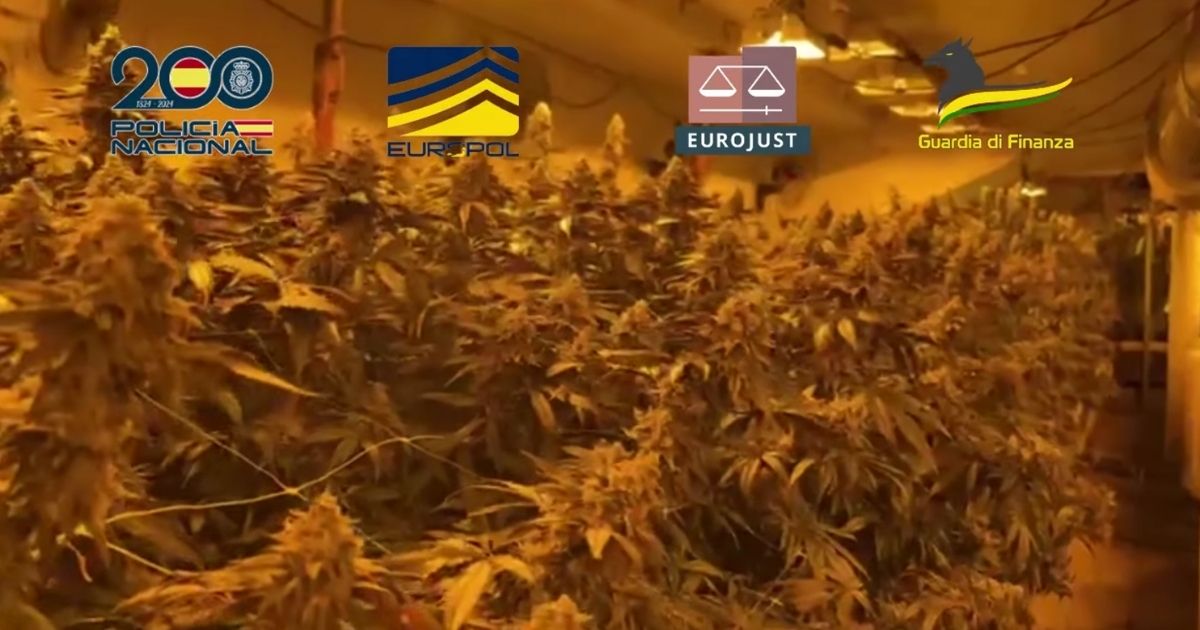
The Barcelona Catania drug network uncovered by Spanish and Italian investigators was built to do two things well: produce cannabis at scale in Spain, then move it discreetly into Sicily for distribution.
That pipeline has now been hit by a joint operation involving Spain’s Policía Nacional and Italy’s Guardia di Finanza, coordinated through Eurojust and supported by Europol, resulting in 12 arrests — six in Spain and six in Italy.
A production base in Spain, a market in Sicily
Eurojust says the group was allegedly led by an Italian national who had moved to Barcelona, working with trusted associates to manage cultivation in Spain and distribution into Italy. The structure reportedly included growers, transporters and money collectors — a division of labour designed to keep the leadership insulated.
What police seized: plants, guns, cash — and a million euros in assets
Searches in Barcelona and Catania uncovered three indoor cannabis farms with a total of 1,670 plants, along with cultivation equipment. Investigators also seized firearms and more than €40,000 in cash, and froze assets valued at around €1 million, including a luxury property in Barcelona and vehicles.
How the drugs were moved
Authorities describe a changing playbook. Early shipments were allegedly concealed in pallets of fruit and vegetables on trucks; later loads were hidden in large sacks of animal feed, heat-sealed to make detection harder. Eurojust also says the group eventually used sea routes to shift drugs at later stages.
Spanish media reporting on the operation has echoed those concealment methods, underlining how heavily organised crime relies on ordinary supply chains to make contraband look routine.
The investigation was already well advanced
This was not a single “one-day” raid. Eurojust says earlier actions had already led to 13 arrests (10 in Italy, 3 in Spain) and the seizure of more than 900kg of marijuana and hashish, alongside weapons. A joint investigation team (JIT) was key to mapping the cross-border structure and sharing evidence between jurisdictions.
Italian wire service ANSA has also reported the operation under the name “Barcellona express–Farfalla”, describing precautionary measures and the wider list of alleged offences, including trafficking and money laundering.
Cross border co-operation
Eurojust says six suspects are under house arrest in Italy, while two suspects are in pretrial detention in Spain — an indication, investigators suggest, of the scale of the case and the risk of flight or evidence tampering.
For Spain, the wider significance is familiar: indoor cannabis production remains a lucrative industry for organised groups because it’s scalable, relatively easy to hide, and can be plugged into international distribution networks that already exist for other illicit goods. Operations like this one show the EU’s enforcement model in action — not one agency, but a coordinated chain stretching from local investigators to cross-border judicial teams.