 Lorraine Williamson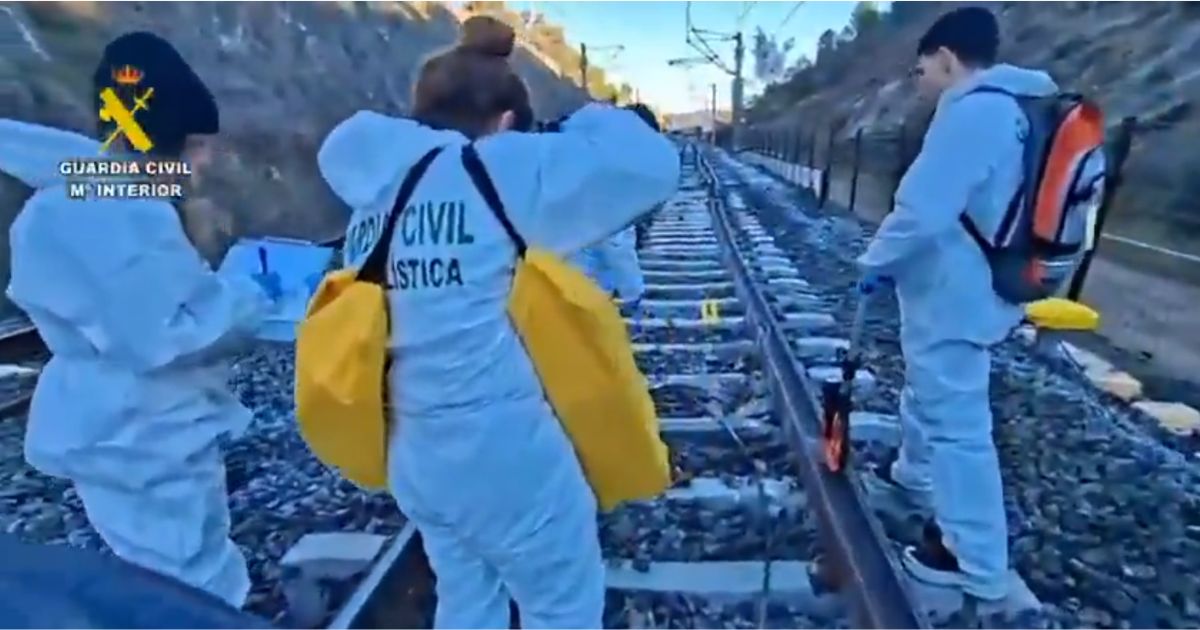
Spain paused at midday today (Monday) as towns, city halls, and institutions held a minute’s silence for the victims of the Adamuz train crash, Spain — a catastrophe that has left at least 39 people dead and more than 150 injured, with some still in intensive care.
The collision happened on Sunday evening near Adamuz (Córdoba), on the rail corridor linking Madrid with Andalucía. Officials have urged caution as investigators begin the painstaking work of establishing why two modern trains on a high-speed network came to grief.
What we know so far about the derailment
According to Adif’s official account, at 7.45 pm on Sunday, a Málaga–Madrid service derailed in Adamuz and invaded the adjacent track. A second train travelling Madrid–Huelva also derailed after the incident.
By Monday, the confirmed toll stood at 39 dead and 152 injured, with 12 patients in ICU, according to national reporting citing official and hospital balances.
The minute’s silence at noon
At 12.00 noon on Monday, 19 January, minutes of silence were observed across the country. RTVE reported commemorations at the Congress of Deputies, outside the Junta de Andalucía headquarters, at the Adamuz town hall, and at party headquarters in Madrid, reflecting the scale of national shock.
In Madrid, the city’s official act took place outside the Palacio de Cibeles, led by Mayor José Luis Martínez-Almeida.
In a statement issued by Madrid City Council, Almeida spoke of the city’s “deepest pain and consternation”, adding that Madrid’s “thoughts and prayers” were with the victims and their families, while thanking emergency teams working “in very difficult circumstances”.
Official statements from Andalucía and Madrid response teams
From the Andalucía side, national coverage has highlighted public remarks by Junta president Juanma Moreno on the evolving hospital situation, while stressing that identification and investigation work will be complex and must be handled with care.
In Madrid, the emergency response has been visible in and around Puerta de Atocha, where passengers and families sought information overnight and into Monday morning. Community emergency teams (SUMMA 112), along with SAMUR and the Red Cross, provided medical and psychological support to people arriving from disrupted services.
Renfe and Adif: assistance, helplines and station support
Adif confirmed it set up a crisis committee at 8.00 pm on Sunday and worked with authorities, emergency services and operators from the outset.
Adif also said Adif and Renfe opened assistance spaces for families at Atocha, Sevilla, Córdoba, Málaga and Huelva, and that psychological support teams were made available to relatives.
Renfe, meanwhile, has announced measures for travellers affected by the suspension of services between Madrid and Andalucía, including flexibility on changes and cancellations while the corridor remains disrupted.
What we don’t know: cause and investigation
Authorities have been clear that the cause is not yet established. Investigators are now working through evidence from the track, signalling, train systems and the sequence of events.
Spain’s high-speed network is built around layered safety systems, which makes the event particularly unsettling. But officials and operators are urging restraint: early theories can collapse quickly under forensic scrutiny, and families deserve facts, not noise.
Practical information: who to contact
If you are trying to confirm a friend or relative’s passenger status, these are the key official contacts being circulated by rail authorities and major outlets covering the response:
-
Emergency (immediate danger): 112
-
Adif family information line: 900 101 020
-
Renfe assistance (PAVAF): 900 10 10 20
-
Iryo assistance line: 900 001 402
If you are in Madrid and need in-person guidance, assistance has been coordinated at Puerta de Atocha, where Protección Civil and emergency teams have supported arriving passengers and relatives.
Travel disruption (for commuters)
Adif says high-speed rail services between Madrid and Córdoba, Sevilla, Málaga, Huelva, Cádiz, Algeciras and Granada remain suspended at least through Monday, 19 January, as recovery and inspection work continues.
Renfe and other operators have issued customer guidance for ticket changes and cancellations while the corridor is disrupted.
Where this goes next
The days ahead will be dominated by three realities: caring for the injured, supporting families through identification and communication, and establishing a clear, evidence-based account of what happened on the line near Adamuz.
For now, Spain’s minute of silence at noon captured something simple and heavy: a country mourning people who were only trying to get home.
Sources: ADIF, Ayuntamiento de Madrid, RTVE