 Lorraine Williamson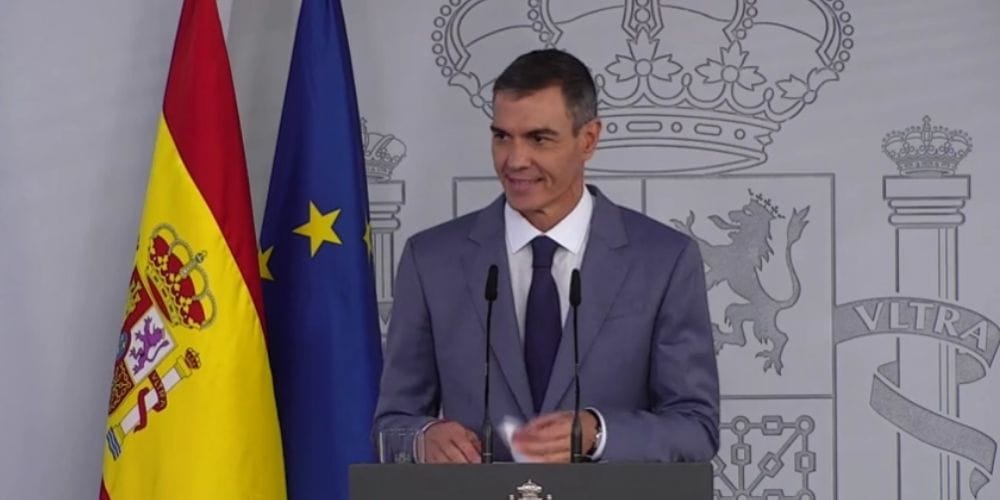
Spain’s government has backed a €10 billion financing programme offering interest-free loans of up to €50,000 to help people buy their first home, as Pedro Sánchez makes a second attempt to push through his housing reforms.
The Council of Ministers approved two new housing decrees on Tuesday, largely restoring measures rejected by Congress last Friday. The package comes a day after Sánchez called a general election for 29 November, following the parliamentary defeat that brought the housing crisis to the centre of Spanish politics.
Under the Tu Casa scheme, buyers will be able to obtain an interest-free loan covering up to 20% of the value of their first habitual home, capped at €50,000. The financing is intended to complement a conventional mortgage or other private financing rather than replace it.
The loans will be available regardless of age, making the programme intergenerational rather than a scheme aimed solely at young buyers. The government has now committed €10 billion to financing the programme, which will be managed through the ICO.
How the €50,000 first-home loans work
The loans can cover up to 20% of the purchase price, subject to the €50,000 maximum. They carry a 0% interest rate and no commissions, with a repayment period of up to ten years.
There is also an unusual feature designed to make the initial years of home ownership more manageable. Repayment can be deferred until the mortgage has been paid off, subject to a maximum grace period of 30 years.
Homes bought using the scheme will be subject to a maximum future sale price. That condition is intended to prevent publicly supported purchases later being used purely for speculative profit.
Government brings back housing decrees rejected on Friday
The financing scheme sits within a much broader package of 21 housing measures. Sánchez said on Tuesday that the two new decrees retain the essence of those defeated in Congress last week, although several changes and additional funding commitments have been introduced.
Friday’s votes saw PP, Vox, and Junts combine to defeat the government’s proposals. The loss prompted Sánchez to spend the weekend considering the future of his government before announcing on Monday that Spain would hold an early general election on 29 November.
Despite parliament now being dissolved, the government remains able to approve royal decree-laws. They must subsequently be considered by the Diputación Permanente, the reduced parliamentary body that continues to perform certain functions while the Cortes are dissolved.
Sánchez urged political parties to support the measures when they return to parliament for validation, arguing that housing is not an ideological question but one requiring an urgent response.
Renters, evictions and affordable housing
The first decree contains the bulk of the government’s measures and covers renters as well as prospective homeowners. Tenants with qualifying rental contracts running until the end of 2028 would be able to request an extraordinary extension of up to two additional years, while protections against certain evictions involving vulnerable households would continue until the end of 2030.
The package also tackles temporary and room-by-room rentals. Temporary contracts would have to state the reason for the tenant’s temporary stay, while the combined rent charged when a property is let by individual rooms could not exceed the amount that would be charged for renting the entire home.
There are also measures aimed at tourist accommodation and empty properties. Tourist lets of fewer than 30 nights would face a specific 10% VAT regime, while councils could impose additional IBI charges on residential properties used for tourist accommodation and long-term empty homes.
More money for social and affordable homes
The government has also committed €400 million for providers of social housing, alongside €280 million in guarantees intended to encourage industrialised housing construction.
State housing company Casa 47 is expected to acquire thousands of properties belonging to the Social Security system and bring them into the affordable housing stock. The government argues that increasing supply is essential if Spain is to address the structural shortage behind much of the pressure on rents and purchase prices.
Another change targets speculative property purchases. Restrictions affecting certain investment funds and large property owners buying homes substantially below their market value are being extended to 2030, rather than ending in 2028 as previously proposed.
Automatic rental extensions face a separate hurdle
The politically more difficult element is contained in the second decree, which deals with the automatic extension of rental contracts.
Under the proposal, once a rental contract reaches the end of its normal term — after at least five years when the landlord is an individual or seven years when the landlord is a company — it would continue for successive periods unless either party gives the required notice.
Where a landlord decides not to renew, compensation for the tenant could apply, subject to a series of exemptions. Under the previous text, that compensation was generally equivalent to at least 12 months’ rent for a comparable property and could not be lower than one month’s rent for each year the tenant had lived in the home.
Crucially, the government has changed how this second decree will operate. It will not take effect until it has been approved by the Diputación Permanente, rather than applying immediately following publication and potentially being overturned later.
Its future is far less certain because the PNV opposed the measure last week alongside PP, Vox, and Junts. The government will therefore still have to secure sufficient parliamentary support before the automatic-extension rules can take effect.
Housing measures now face parliamentary test
The distinction between Tuesday’s government approval and final parliamentary approval is important. The Council of Ministers has approved the new decrees, but they still face the constitutional process required for decree-laws.
The first decree, containing the €10 billion first-home financing programme and most of the government’s housing package, appears to have a clearer route through the Diputación Permanente under its different parliamentary arithmetic. The second decree concerning automatic rental extensions remains considerably less certain.
That means prospective buyers and tenants should not assume every measure announced on Tuesday is already available or permanently in force. Publication in the BOE and the subsequent parliamentary process will determine when individual measures take effect and whether they ultimately remain law.
With Spain now heading towards a general election on 29 November, housing is likely to remain one of the defining political issues of the campaign. The government’s decision to revive the measures just four days after their parliamentary defeat ensures that the argument over how Spain tackles its housing crisis is far from over.