 Lorraine Williamson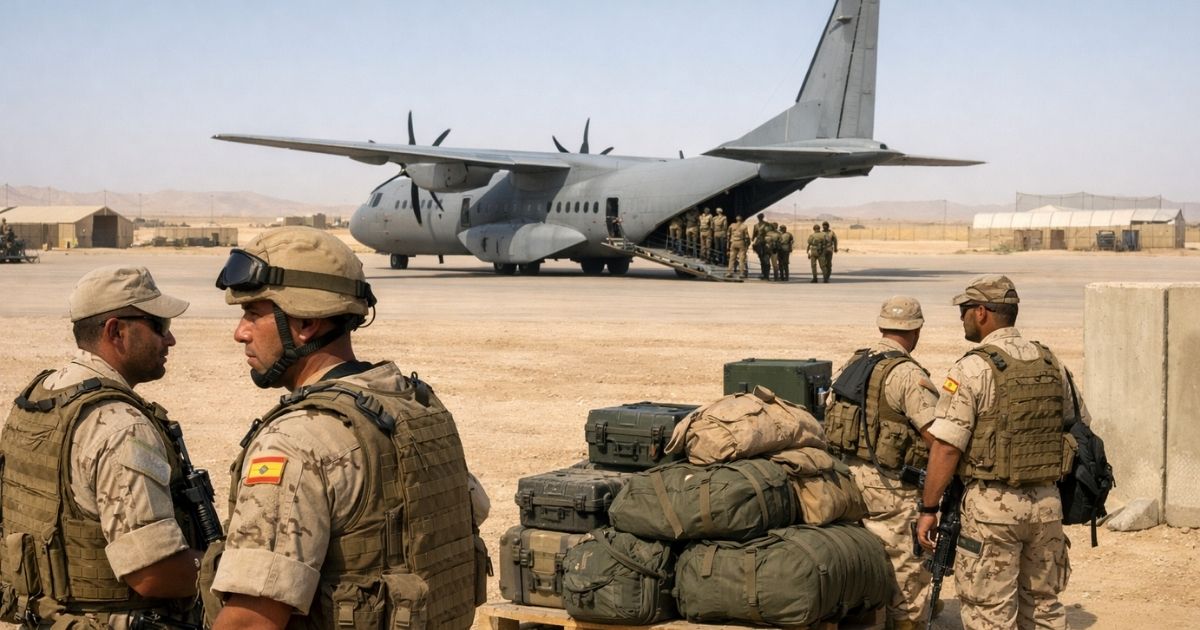
Spain has begun relocating military personnel from Iraq as the war involving Iran continues to destabilise the wider region, turning what started as a precautionary plan into a live military movement. Defence Minister Margarita Robles said earlier that Spanish troops would be moved because of rising danger on the ground, and newer reporting on Thursday evening indicates the process is already underway.
Reuters reported on Wednesday that Spain planned to evacuate and relocate troops deployed in Iraq in the coming days because of security risks linked to the Iran war and the broader Gulf crisis. Spain has about 300 troops in Iraq. Some are part of the international coalition against ISIS, and others are part of a NATO training mission. Robles said they are being moved for safety, but she did not say where they are going.
By Thursday, Anadolu reported that Spanish soldiers were being transferred to Turkey, with Robles saying an additional 200 troops were expected to be evacuated “in the coming hours”. That suggests the story has moved beyond contingency planning and into active repositioning, even if Madrid has not yet publicly set out the full timetable.
A mission reshaped by regional escalation
The backdrop is a broader deterioration in Middle Eastern security. Reuters has reported that Spain has already distanced itself politically from the conflict, ruling out participation in military operations in the Strait of Hormuz and rejecting pressure to join a broader campaign. That has left Madrid trying to balance two priorities: protecting its personnel and avoiding deeper entanglement in a conflict it has criticised.
The NATO dimension matters too. Spain’s troops in Iraq are split between Operation Inherent Resolve and the NATO Mission Iraq, which has focused on advising Iraqi government forces since 2018. NATO said on Thursday that allies and Gulf partners had held talks on the security situation in the Middle East and its impact on regional and Euro-Atlantic security, underlining how seriously the alliance is treating the fallout.
Why this matters for Spain
For Spain, this is not simply a distant foreign-policy story. It is part of a broader national response to a conflict that is already affecting energy markets, defence planning, and budget decisions. Reuters reported on Thursday that Pedro Sánchez’s government has delayed presenting its 2026 budget. Meanwhile, it rushes to address the economic impact of the war in Iran, including surging fuel and electricity costs linked to turmoil in the Gulf.
That gives the troop relocation wider significance. It shows the crisis is no longer something Spain is merely commenting on from afar. It is already reshaping military deployments, economic planning, and diplomatic positioning at home.
What happens next
The immediate question is whether Spain’s move proves to be a temporary repositioning or the start of a broader withdrawal from Iraq. For now, official messaging points to relocation for safety rather than a permanent exit. But with NATO adjusting its posture, attacks and threats spreading across the region, and European governments increasingly wary of being dragged deeper into the conflict, the situation remains fluid.
For Spanish readers, the clearest takeaway is this: Madrid is no longer preparing in theory. It is now actively moving troops out of harm’s way.