 Lorraine Williamson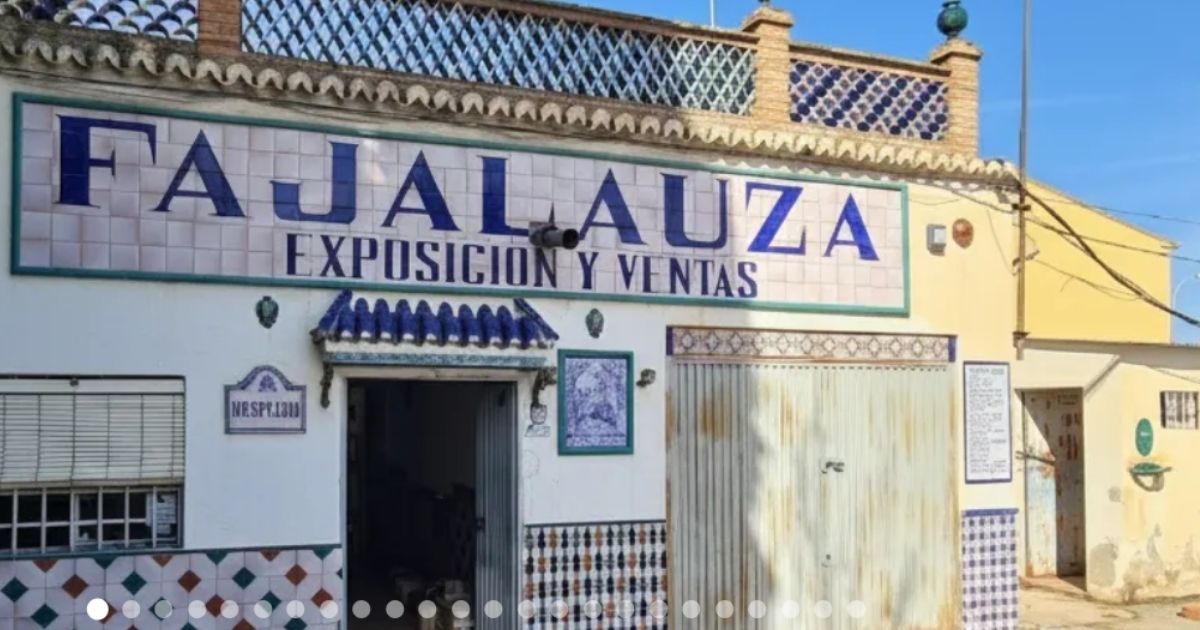
The Fajalauza ceramics Granada guide you didn’t know you needed starts with a simple question: why does Granada seem to leave a trail of blue-green pottery everywhere you look? On door numbers and patios, on shop walls, in bowls the size of basins, in tiles that feel as if they’ve always belonged to the city.
Fajalauza isn’t just “pretty ceramics”. It’s one of Granada’s oldest surviving craft languages — a style rooted in tin-glazed earthenware and hand-painted motifs, with the pomegranate at its centre. Records place the Morales family in Granada’s potters’ guild as early as 1517, and their workshop is widely cited as the only historic factory still producing in the traditional way.
The look: why it’s instantly recognisable
Authentic Fajalauza tends to announce itself before you even register the pattern. The glaze is stanniferous — that soft, opaque white that gives the surface a chalky brightness — and the palette is classic Granada: cobalt blue-grey, copper green and, often, a darker manganese tone that deepens outlines and flourishes.
The motifs are less “designed” than lived-in. Leaves and flowers, birds, laced geometric forms, heraldic touches, and that stylised pomegranate that works almost like a signature of place.
If you’re holding a piece that feels too perfect — identical line weights, dead-even colour, printed sharpness — it may be decorative Granada-style rather than true workshop Fajalauza. The real thing carries small variations, because it’s painted by hand.
A name borrowed from a gate, not a brand
Fajalauza began as geography. The name is tied to the Puerta de Fajalauza, a historic gateway in the Albaicín area, where potters once clustered on the edge of the old city walls. Over time, the place-name became the shorthand for the ceramics made around it.
That matters because Fajalauza is a tradition first, a shop label second. You’ll see “Fajalauza-style” pieces across Andalucía and beyond, but the lineage runs back to Granada’s pottery neighbourhoods and the long afterlife of Moorish-era techniques in a Christian city.
The Morales workshop: five centuries, one family line
Among Granada’s historic factories, the Morales Moreno workshop is repeatedly singled out as the last to preserve continuous production in the old tradition, with techniques passed through generations and a body of work that travelled far beyond Spain.
Fajalauza isn’t only something you buy. It’s a living craft economy that survived industrialisation by staying stubbornly handmade — and by adapting just enough to remain relevant.
Where to see it in Granada without trying
Start in the Albaicín. Even if you never set foot in a workshop, you’ll spot Fajalauza in the small, ordinary places where tourists rarely linger: house plaques, stairwells, courtyards, neighbourhood bars. It’s one of the few crafts in Spain that still functions as everyday visual culture rather than museum heritage.
Then watch for the pomegranate. Not the hyper-real fruit you’d see on mass-produced souvenirs, but the stylised emblem that looks like it belongs on a coat of arms. That motif is a strong tell, and it’s central to the tradition’s identity.
Visiting and buying: how to do it thoughtfully
If you want to go beyond the shop window, the Fundación Cerámica Fajalauza sets out a preservation mission focused on protecting the tradition as intangible cultural heritage and strengthening authenticity standards. It also lists a “Centro de Interpretación” concept linked to the Morales family’s long-running factory and provides practical contact details and opening hours.
For readers, the most useful takeaway is simple: when you buy directly from historic makers or trusted Granada specialists, you’re not just taking home a souvenir. You’re helping keep a local craft alive in a city where mass tourism can flatten everything into the same three colours.
Why it still matters now
Fajalauza has become one of those Granada signatures that’s so familiar it turns invisible — like the sound of water in courtyard fountains, or the way the Albaicín tilts towards the Alhambra. But the tradition is not guaranteed. The more imitation spreads, the more important the original workshops become.
And that’s the quiet story behind the tiles you keep seeing: a five-century craft that still insists on being handmade.