 Lorraine Williamson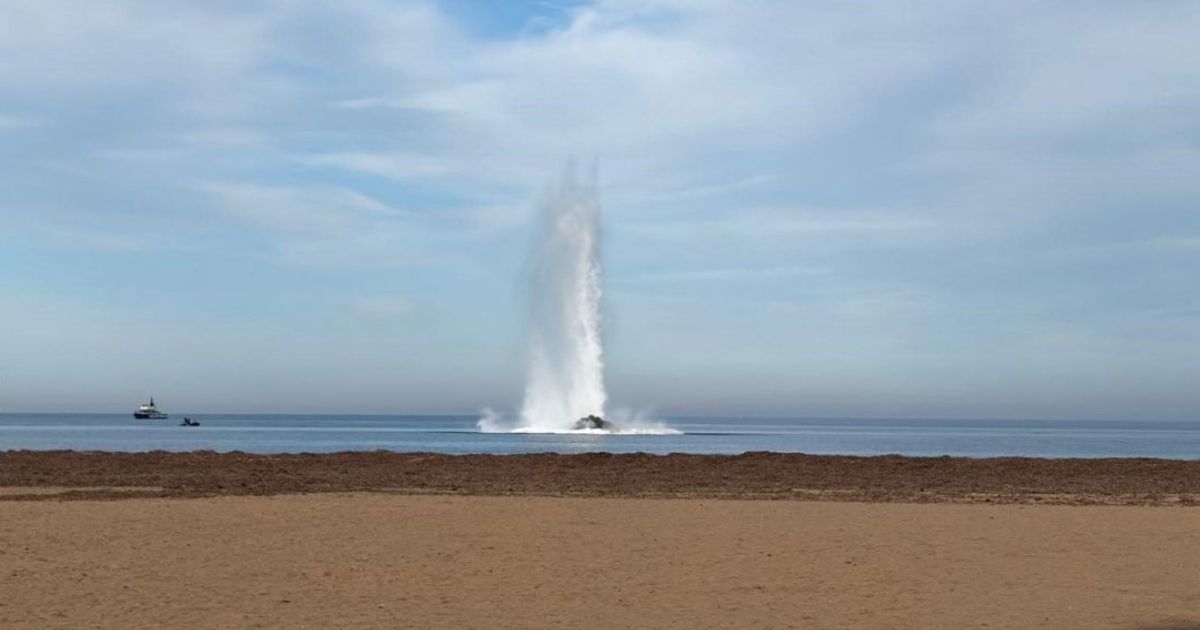
A suspected relic from the Spanish Civil War that turned up under the sea near Playa de Les Albaranes in Dénia earlier this month has now been safely detonated in a controlled explosion offshore. The detonation took place on 14 January 2026. This was several hours after the object was first reported by recreational divers and confirmed by security forces.
The operation began when a group of sport divers spotted a suspicious metallic object about 400 metres off the coast. The object was submerged roughly four metres beneath the surface and hidden by marine growth. Following safety protocols, the find was reported to the emergency services by phone.
Multi-agency response and safety perimeter
Once alerted, the Guardia Civil’s Special Underwater Activities Group (GEAS) verified and marked the site. They then notified the Centro de Operaciones y Vigilancia de Acción Marítima (COVAM), the maritime command centre of the Spanish Navy based in Cartagena. From there, a specialist Explosive Ordnance Disposal Team (EDE) from the Navy’s Mine Countermeasures Diving Unit (UBMCM) was dispatched to undertake the neutralisation.
Local authorities, including the Policía Local of Dénia, National Police, the Civil Guard’s maritime service, Red Cross, and SAMU emergency medical services, supported the operation. A safety perimeter was established on land and at sea to protect bystanders while the team prepared for controlled detonation.
Controlled detonation and aftermath
By mid-afternoon, after careful preparations, the specialised team placed explosive charges designed to neutralise the device in situ. The shell was then detonated in a controlled explosion at sea. Although it sent a column of water skyward, it posed no danger to the public. A subsequent dive confirmed the risk had been eliminated. Consequently, the security perimeter was gradually lifted, and normal beach activity resumed.
This method (detonating hazardous artefacts where they lie ) is standard when moving an unstable device, which could pose a greater risk than neutralising it on site.
The Guardia Civil later confirmed the outcome publicly. They stated that the Civil War-era explosive device was neutralised through a controlled detonation by a specialised security unit, with the operation completed without incident.

@Jaes_GC
Why these wartime finds still occur
Spain’s extensive coastline and its history as a battleground during the 1936–1939 Civil War mean that unexploded ordnance (UXO) occasionally surfaces, especially in areas involved in coastal defence. Many of these shells and bombs were fired or dumped decades ago and have since become buried under sediment or encrusted by marine life before being uncovered by storms, shifting sands or, as in this case, divers.
While most discoveries are harmless artefacts, authorities treat any unidentified metal object found underwater or on shore as potentially dangerous. Protocols require immediate reporting and professional assessment.
Advice for the public
If you come across any unusual metallic object on a beach or underwater, avoid touching or moving it. Mark the location if possible and call emergency services immediately (dial 112) so specialists can assess and respond safely.
Known hotspots
Findings like the Dénia shell remind us that Spain’s 20th-century history still resonates physically along its shores. Local diving clubs, maritime authorities and heritage bodies continue monitoring known hotspots where wartime ordnance might emerge. Greater public awareness of reporting procedures helps ensure these relics are handled safely — preserving both coastal heritage and community wellbeing.