 Lorraine Williamson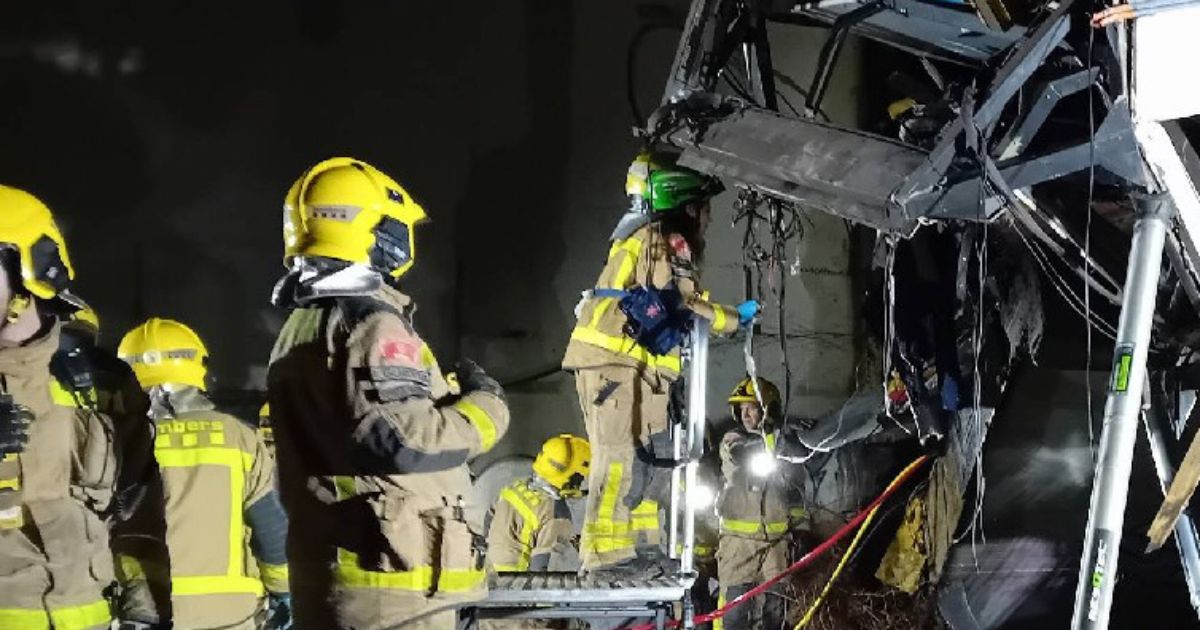
A commuter train derailment near Gelida has been formally linked to heavy rainfall and a landslide, as Spain’s rail network comes under renewed scrutiny following a second fatal crash in just days. The driver was killed, and 37 passengers were injured, five of them seriously, after a retaining wall collapsed onto the tracks on Tuesday evening.
The incident occurred at around 9.02 pm on the R4 Rodalies line, between Sant Sadurní d’Anoia and Gelida, when the train struck the fallen structure and derailed. Most of the injured were travelling in the front carriage, which absorbed the impact. One passenger was trapped and had to be freed by emergency services.
Heavy rainfall and soil saturation under investigation
According to emergency services and official sources, recent heavy rainfall is believed to have played a key role in destabilising the wall. Around 100 litres of rain per square metre fell in the Sant Sadurní d’Anoia area over the course of a week, with 24 litres recorded on Tuesday alone.
Firefighters said water accumulation likely contributed to a small landslide, weakening the structure and causing it to collapse onto the line. The wall has since been stabilised to prevent further movement, while engineers continue to assess the surrounding terrain.
The incident mirrors previous weather-linked failures on the same line, reinforcing concerns that extreme rainfall is exposing long-standing vulnerabilities in rail-side infrastructure.
Driver killed, dozens treated by emergency services
Catalonia’s emergency medical service SEM, treated 37 people at the scene. Five were classed as seriously injured, six suffered moderate injuries and the remaining 26 sustained minor wounds. All were taken to hospital.
The train driver died at the scene. Authorities have confirmed that several railway employees were inside the cab at the time of the collision, possibly including trainee drivers, although details of the final moments have not yet been released.
Rail services suspended across Catalonia
Following the crash, all Rodalies services across Catalonia were suspended at the request of the train drivers’ union SEMAF, which called for comprehensive inspections after days of severe weather.
The Catalan government accepted the request. Speaking from the coordination centre in Sant Sadurní d’Anoia, Sílvia Paneque, Catalonia’s Minister for Territory, said services would not resume until full test runs confirm that every line is safe. At the time of writing, services were suspended at least until mid-morning.
Weather conditions had already caused widespread disruption earlier in the day, with temporary suspensions in Girona and delays of up to 30 minutes reported in Tarragona and Lleida.
Second derailment highlights wider weather impact
The Gelida crash was not the only incident on Tuesday. A second train derailed on the R1 line between Blanes and Maçanet de la Selva after rocks fell onto the tracks. No injuries were reported, but the line was also suspended.
Together, the incidents have sharpened focus on how persistent rain, saturated ground and ageing infrastructure are combining to disrupt rail travel across the region.
Rodalies under renewed pressure
The latest derailment adds to a long history of serious incidents on the Rodalies network. In 2018, an R4 train derailed near Vacarisses after a wall collapsed following heavy rain. In 2019, a female driver was killed in a collision involving two R4 trains. Earlier incidents include a buffer-stop crash at Estació de França in Barcelona in 2017.
The timing is politically sensitive. Rodalies is currently in the process of being transferred to a joint company run by the Catalan and central governments, while operations remain with Renfe and infrastructure under Adif.
National reaction amid rail safety concerns
The crash came just days after a separate high-speed rail disaster near Adamuz, Córdoba, which killed more than 40 people, putting rail safety firmly in the national spotlight.
Prime Minister Pedro Sánchez expressed condolences to the victims and their families, while opposition leader Alberto Núñez Feijóo highlighted the death of yet another train driver in Catalonia. Carles Puigdemont pointed to the fact that two derailments occurred on the same day, with dramatically different outcomes.
As investigations continue, weather resilience, slope stability and infrastructure maintenance are expected to remain central to the findings — not only for this crash, but for the future of rail travel across Catalonia.
Sources: Wikipedia, Spanish News Today, El País