 Lorraine Williamson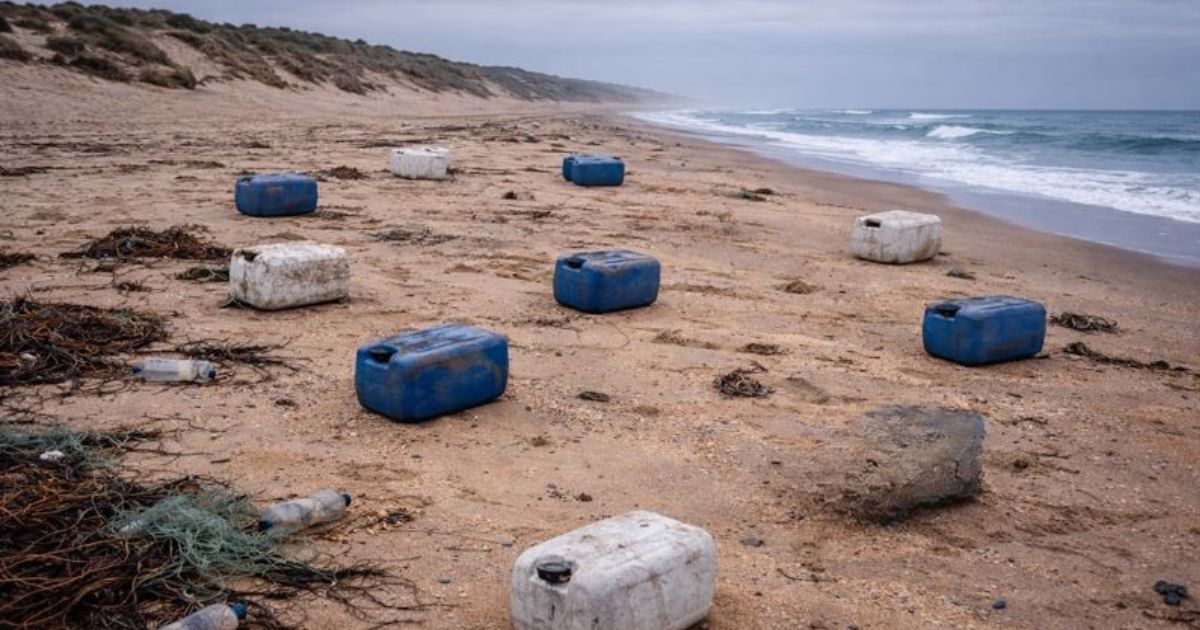
The tide is leaving more than seaweed on Spain’s Atlantic edge. Doñana narco fuel jerrycans have been turning up along the sands near Matalascañas, in Huelva, scattered across stretches of coastline that sit beside one of Europe’s most protected ecosystems.
For environmental volunteers, the containers are a blunt sign of something locals already know: the drug routes don’t end at sea. They also leave a footprint on land.
A plastic trail from a maritime business
The containers are the kind used to feed high-powered boats. In the slang of the southern coast, it’s tied to petaqueo — the refuelling logistics that keep fast craft moving. Once they’re empty, they can be tossed overboard and carried by currents until they wash up onshore.
Activist Enrique Herrero, widely known online as Quique Bolsitas, has been documenting the latest strandings and warning that it is getting worse, not better.
Why it matters in Doñana
Doñana is not just another beach-clean headline. The marshes and dunes form a globally recognised wetland system, protected under multiple international frameworks. Conservation groups argue the damage from fuel residues and plastic breakdown is more than visual: it can seep into sand, be ingested by wildlife, and add pressure to habitats already under strain.
The problem is also practical. Some of the worst-hit areas are remote, with limited access for heavy clean-up equipment. That leaves volunteers and local services trying to plug gaps, often after storms or heavy swells bring in a fresh wave.
Fuel, boats and arrests by Guardia Civil
“Europe’s biggest park without physical surveillance”?
On the security side, the issue keeps circling back to geography. The coastline is long, open, and hard to police in the way ports can be policed.
In recent public warnings, representatives of the Guardia Civil’s AUGC association in Huelva have described Doñana as a key entry point for trafficking and criticised the lack of “physical surveillance” across such a vast protected space.
Another battle line: the coastal boundary dispute
The jerrycans are the visible crisis. But Doñana is also caught in a slower, more technical fight over how parts of the marshland are classified.
Spain’s environment ministry (MITECO), through the Directorate-General for the Coast and the Sea, has approved a coastal boundary designation (deslinde) covering the Doñana marshes area across parts of Huelva and Seville provinces, with the decision published via official channels.
WWF and a group of more than 270 scientists say the approach risks reinterpreting the marshes in ways that could weaken protection for freshwater wetland systems, and they have urged the ministry to halt and revisit the framework using independent scientific assessment.
The row matters because classification shapes what rules apply and what interventions can follow.
A protected landscape, treated like a dumping ground
Doñana’s crisis is no longer a single story. It is criminal logistics washing onto sand, and policy arguments playing out in the background.
The jerrycans make the point in the starkest way. If Spain wants Doñana to stay a symbol of protection, not neglect, the response has to be faster than the tide.