 Lorraine Williamson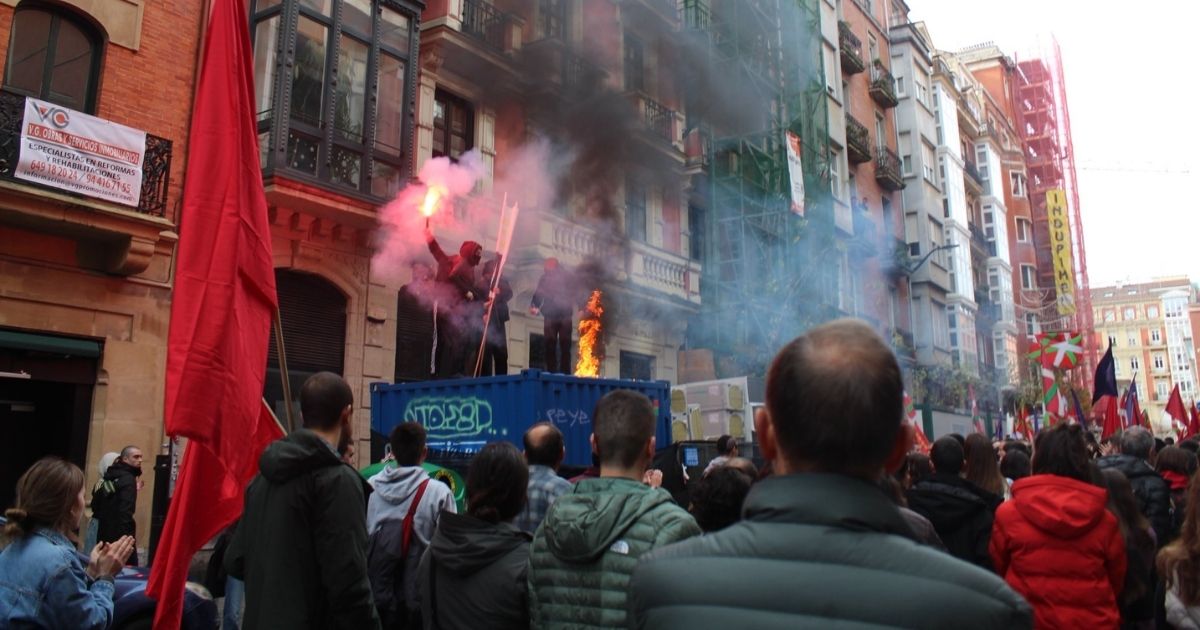
A Basque youth independence march through central Bilbao ended in controversy on Saturday after a small group of masked demonstrators burned a Spanish flag in full view of the crowd.
The incident unfolded during a demonstration organised by Ernai, a radical youth movement linked to the Basque pro-independence left. Hundreds of young people took part, moving from the city centre towards the old town behind banners calling for independence and political action.
Flag burning draws applause from part of the crowd
As the march passed through an area of building works, four youths climbed onto construction cabins, ignited a flare and set fire to a Spanish flag. The act lasted only moments, but it drew loud applause from sections of the demonstration and quickly spread on social media.
The march itself was heavily marked by Basque symbolism. Ikurriñas were raised throughout the route, alongside flags from neighbouring Navarra, while chants denounced fascism, capitalism and sexism, blending national demands with wider ideological messages.
Heavy police presence around state buildings
The Basque police force, Ertzaintza, monitored the demonstration closely. Officers were deployed around sensitive locations, including Spain’s maritime authority building and the headquarters of the moderate nationalist party PNV.
No arrests were reported during the march, which concluded with speeches in Bilbao’s historic centre. Organisers framed the demonstration as proof that a new generation is prepared to push for independence despite what they described as ongoing attempts to reinforce Spanish national identity in the city.
Youth activism at the sharp edge of Basque politics
Ernai operates as the youth wing of Sortu, a party that forms part of the broader EH Bildu coalition. While EH Bildu pursues independence through democratic institutions, Ernai is known for its confrontational street politics and uncompromising rhetoric.
Sortu itself emerged from the political space left after the banning of earlier nationalist parties linked to ETA, which formally disbanded in 2018 after decades of armed struggle. Unlike ETA, Sortu rejects violence and operates within Spain’s legal framework, though critics argue that symbolic acts like flag burnings continue to inflame tensions.
Identity, autonomy and a divided nationalist movement
More than seven years after ETA laid down arms, questions of identity, language and sovereignty remain highly charged in the Basque Country. For some young activists, Spanish state institutions still represent an unwanted presence. For others, particularly supporters of the PNV, greater autonomy within Spain remains the preferred route.
Saturday’s march highlighted those internal divisions. It also underlined how Basque youth activism continues to shape the tone of the independence debate, keeping it visible, provocative and firmly rooted in the streets rather than parliament alone.
Source: El Mundo