 Lorraine Williamson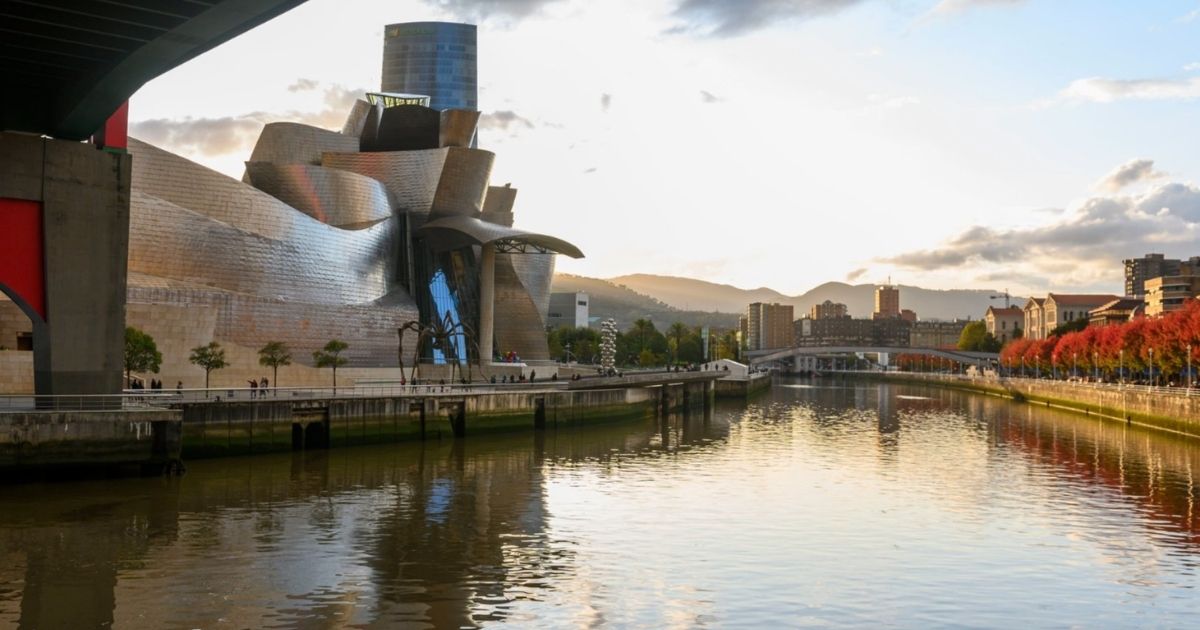
Spain is home to some of Frank Gehry’s most imaginative works, buildings that reshaped city skylines and helped redefine how architecture can transform a place’s identity. His death on 5 December 2025, at the age of 96, has prompted renewed reflection on the legacy he leaves behind — a legacy that stretches far beyond sculptural forms and into the social and economic fabric of the cities he touched.
Gehry’s architecture has long carried a sense of movement. Titanium, glass, stone, and steel appeared to shift and ripple under natural light, creating structures that felt alive. While he worked across continents, Spain became one of the countries where his artistic vision sparked cultural change on a remarkable scale.
The Bilbao transformation: Guggenheim Museum (1997)
Few buildings have altered a city’s fate as dramatically as the Guggenheim Museum Bilbao. When it opened in October 1997, the post-industrial city was grappling with economic decline. Gehry’s sweeping design — its titanium panels shimmering beside the Nervión River — offered an entirely different story.
Inside, the vast atrium rises like a cathedral of light, with bridges, stairways and balconies spiralling around its core. The museum became an instant symbol of contemporary culture, drawing millions and triggering what is now known worldwide as the “Bilbao Effect”: the power of bold architecture to revitalise a city. Tourism boomed, confidence returned, and Bilbao emerged as one of Europe’s essential cultural destinations.
Wine, colour and landscape: Hotel Marqués de Riscal (2006)
In the Rioja Alavesa wine region, Gehry created a building that pairs theatrical energy with the traditions of one of Spain’s most historic bodegas. The Hotel Marqués de Riscal appears almost to hover over Ricardo Bellsola’s 19th-century cellars, its metallic ribbons unfurling in purple, gold and silver.
The colours are not decorative flourishes but a nod to the winery’s identity: the deep tones of Rioja wine, the golden bottle mesh, the silver capsule around the cork. The hotel transformed Elciego from a quiet winemaking village into a design landmark, drawing visitors from across the world who now blend wine tourism with architectural pilgrimage.
Barcelona by the sea: Peix d’Or (1992)
On Barcelona’s Olympic Port, Gehry left a very different kind of signature. The enormous Peix d’Or — the golden fish sculpture commissioned for the 1992 Olympic Games — curves above the shoreline like a creature frozen mid-swim. Its metallic scales catch the Mediterranean light, shifting from bronze to pale gold as the day changes.
Although static, the sculpture gives the impression of motion, echoing both the maritime heritage of the city and Gehry’s long-standing fascination with fish forms. Over the decades, it has become one of Barcelona’s most photographed coastal landmarks.
How Gehry reshaped Spain’s urban story
Gehry’s legacy in Spain is not merely aesthetic. His buildings illustrate how art, tourism and local identity can interact in ways few planners anticipated before the 1990s. The Guggenheim put Bilbao on the global map. Elciego reinvented itself as a luxury wine-design destination. Barcelona’s port gained a symbol that still features in campaigns promoting the city’s waterfront revival.
His work also encouraged municipalities to see architecture as a catalyst rather than a decoration. Cities across Spain began investing in cultural spaces, design districts and public art, inspired by the confidence he helped unlock.
Spain’s architectural landscape after Gehry
As Spain reflects on Gehry’s legacy, the conversation shifts from individual buildings to the wider movement they inspired. His approach helped open the door for bolder public projects, greater experimentation with materials and a renewed understanding of how design can influence economic growth.
Gehry’s death closes a chapter, but the cities he reshaped continue to evolve in the shadow — and light — of his ideas. Spain’s cultural landscape carries his imprint, not only in its architecture but in the belief that visionary design can change the trajectory of a place.
Sources: Mira Espanha, El País, Guggenheim Bilbao, Design Boom