 Lorraine Williamson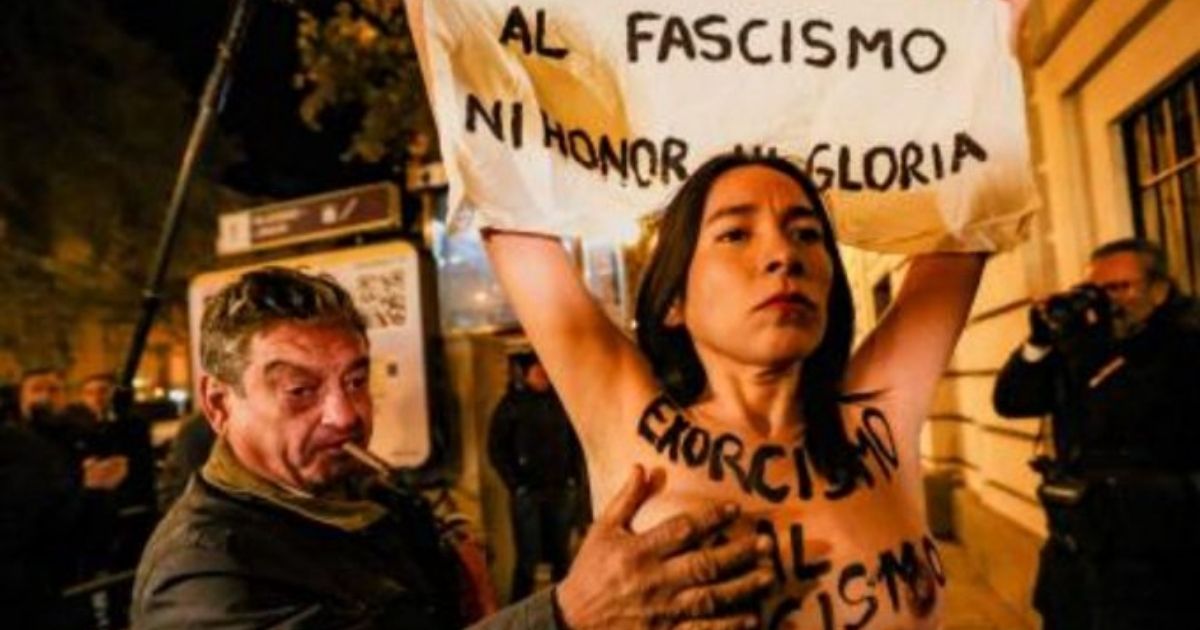
For decades, the annual Mass on 20 November, honouring Francisco Franco, has drawn a loyal, older crowd. Yet this year’s gathering in Madrid revealed a striking generational shift that unsettled even long-time observers. A notably young audience — far larger than in previous years — filled the streets around the Parroquia de los Doce Apóstoles, reshaping the tone of an event long associated with Spain’s ageing far-right faithful.
By midday, the church was packed, but what caught attention was the demographic. Groups of young adults in leather jackets and sunglasses queued alongside veteran supporters of the Francisco Franco National Foundation and members of the Franco family. The contrast was stark, and the mood more defiant than devotional.
Some spoke openly of a reborn patriotism, echoing rhetoric heard in recent years across parts of Europe. Outside, stalls displayed Francoist flags, portraits of the dictator and other symbols outlawed in many neighbouring countries but still legally sold in Spain. The priest, aware of the scrutiny, kept his sermon brief, avoiding commentary that could turn the religious service into a political rally.
Activist intervention jolts the gathering
The uneasy balance was shattered when two Femen activists arrived bare-chested, their bodies marked with slogans rejecting fascist glorification. Their appearance triggered immediate hostility. Witnesses described men shouting, pushing and chasing the women, one of whom endured unwanted touching as she tried to leave. The activists eventually withdrew without police intervention, but the encounter left a clear reminder of how raw the debate around Spain’s authoritarian past remains.
What the youth turnout tells us
The large number of young attendees sparked renewed discussion about why nostalgia for a dictatorship that ended nearly half a century ago persists among people who never lived through it. A recent 40dB survey, widely cited in Spanish media, found that a segment of younger Spaniards expresses openness to authoritarian models under certain circumstances. That undercurrent helps explain the unusually youthful presence at this year’s memorial.
Historians note that debates over the past often intensify when economic uncertainty and political polarisation rise — a pattern Spain has not escaped. Social media communities, far-right influencers, and online forums have also played a role in shaping a new identity centred on Francoist nostalgia, repackaged for a generation raised in the digital world.
Inside the church, a veneer of calm
While tension flared outdoors, the mass itself remained subdued. Long queues formed for communion, but beyond that, the congregation sat in silence, aware of the commotion outside. Once the ceremony ended, Francoist songs echoed through nearby streets as congregants mingled with onlookers.
The scene illustrated a recurring contradiction: a religious service intended to appear apolitical, yet unfolding in the shadow of Spain’s unresolved historical wounds. Each year brings the same clash — remembrance on one side, rejection on the other — with little sign of reconciliation.
Where the debate goes next
This year’s young turnout adds a new dimension to an already contentious anniversary. The confrontation between activists and attendees underscores how memories of dictatorship still fracture public life, shaping conversations about democracy, identity and the future Spain wants for itself.
With generational lines now clearly visible, the legacy of Francoism is no longer a debate of the past — it has firmly re-entered Spain’s present.
Sources: La Vanguardia, El País